NVIDIA's Vision for AI in Retail: Shopping Assistants, Digital Twins and the Rise of Physical AI
NVIDIA's Azita Martin argues retail AI has moved from pilots to deployment, with conversational shopping assistants, Omniverse digital twins of stores and distribution centres, and physical AI that perceives and acts in the real world.
- 1Conversational shopping assistants can capture the knowledge of a retailer's best sales associates and make it available online at scale, combining natural language, visual search and full journeys from discovery to basket.
- 2Digital twins built in NVIDIA Omniverse let retailers simulate store layouts, fulfilment workflows and distribution centre throughput before making expensive physical changes.
- 3Physical AI, underpinned by the Cosmos Nemotron model trained on billions of hours of video, allows cameras, agents and robotics to perceive events and coordinate responses in warehouses and stores.
Generative AI is moving beyond experimentation and into the infrastructure of retail. From conversational shopping assistants that behave like a retailer's best sales associate to digital twins that simulate stores and distribution centres, NVIDIA believes the next phase of AI will transform both the digital and physical sides of the industry.
Retail's AI conversation is changing.
The past few years have been dominated by experimentation: pilots, proofs of concept and questions about where generative AI could deliver meaningful value.
Now, according to Azita Martin, Vice President and General Manager of Retail and CPG at NVIDIA, the technology is beginning to move from experimentation into real-world deployment.
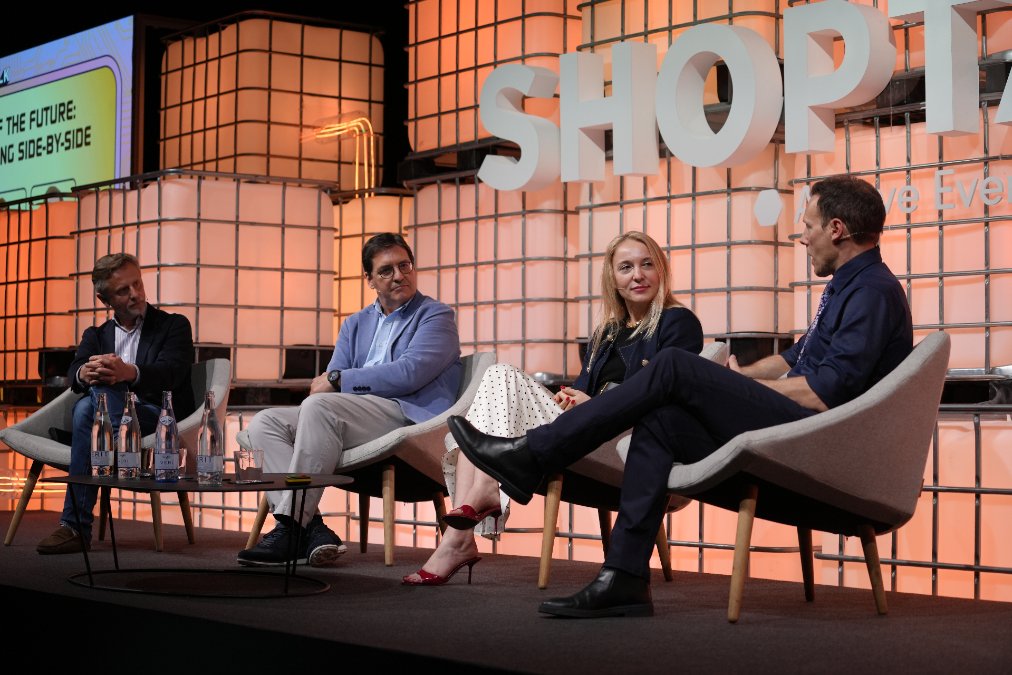
Speaking with Alex Rezvan, Founder of The Retail Podcast, Martin described generative AI as an emerging "AI factory" in which a company's data becomes the raw material used to create digital intelligence.
Retailers can fine-tune AI models using documents, product information, customer data, images and video, creating agents capable of supporting employees and customers at scale.
The implications stretch far beyond chatbots.
NVIDIA's vision encompasses e-commerce, stores, distribution centres, robotics and even the way retailers design physical environments.
And Martin believes companies willing to move early could establish a significant advantage.
The Shopping Assistant Could Become Retail's Digital Sales Associate
One of the clearest opportunities for generative AI is e-commerce.
Traditional online shopping remains heavily dependent on keywords, filters and product pages. Customers must translate what they actually want into language a search engine understands.
Conversational AI changes that relationship.
Five Things Friday
Five useful signals from the people shaping global retail. Every Friday.
Instead of searching for "black midi skirt" and manually browsing dozens of products, a shopper could explain where they are going, what they want to wear and what matters to them.
The AI can then interpret the request, recommend products and continue the conversation.
Martin described the opportunity as effectively capturing the knowledge of a retailer's best sales associates and making it available online, 24 hours a day and at scale.
That idea was demonstrated by Cynthia Countouris, Director of AI for Retail and CPG at NVIDIA, using NVIDIA's retail shopping assistant technology.
Rather than forcing customers to think in search terms, the assistant allows them to communicate naturally.
A shopper preparing for an outdoor lunch, for example, could simply ask for an appropriate dress or skirt. The assistant could recommend an outfit and then answer follow-up questions about care instructions, price, comfort or reviews without forcing the customer to navigate between multiple product pages.
The experience begins to resemble a conversation with an experienced store associate rather than interaction with a traditional e-commerce search bar.
Visual Search Makes Product Discovery More Human
The transformation becomes more interesting when AI begins understanding images alongside language.
During the demonstration, an image of a pair of shoes was uploaded and the shopping assistant searched the retailer's catalogue for visually similar alternatives.
It did not simply identify "red shoes."
The system could interpret characteristics such as straps, ankle details and embellishments before finding comparable products.
Customers could then continue asking natural questions about heel height, pricing, comfort or ratings.
This represents an important shift in e-commerce discovery.
Consumers do not always know the technical terminology required to describe what they want.
They may simply have seen a product on social media, on another person or somewhere else online and want something similar.
AI allows retailers to move closer to that natural behaviour.
From Product Search to Complete Shopping Journeys
NVIDIA's vision goes beyond making search more conversational.
Shopping assistants could eventually connect discovery, recommendations and transactions into one continuous experience.
A consumer could ask for a skirt, request tops and shoes to complete the outfit, compare options and ultimately add products to their basket without repeatedly restarting the search journey.
For retailers, that has implications beyond customer experience.
Martin argued that generative AI presents opportunities to improve search and deploy shopping assistants while also creating new commercial opportunities across e-commerce and retail media.
AI-generated advertising and more intelligent digital experiences could potentially help retailers generate additional revenue from relationships with consumer packaged goods companies.
In other words, AI could simultaneously improve discovery, increase conversion and create new monetisation opportunities.
Furniture Shows What Happens When AI Meets Digital Twins
Perhaps the most striking demonstration came from furniture retail.
Furniture has always presented a difficult e-commerce challenge.
Customers can browse products online, but understanding how a sofa, table or chair will actually look inside their home remains difficult.
NVIDIA demonstrated how AI could combine conversational commerce with a three-dimensional representation of a customer's room.
Using a mobile device, a consumer could scan their living space to create a 3D model, which could then be brought into NVIDIA Omniverse.
The customer could ask for a modern sofa, receive recommendations and virtually replace the existing sofa with a 3D representation of a product from the retailer's catalogue.
If the first recommendation did not work, the customer could simply ask to try another.
No product codes. No complicated design software. Just conversation.
The same approach could then be extended to tables, chairs, lamps and other products until the customer had effectively redesigned the room.
It transforms e-commerce from browsing products into experimenting with outcomes.
Digital Twins Could Transform Stores and Supply Chains
The same principles become even more powerful behind the scenes.
Martin identified supply chain as one of the areas where AI could have the greatest impact.
NVIDIA is developing what it describes as physics AI: AI capable of understanding dimensions, volume and the behaviour of people and objects within physical environments.
Retailers can create physically accurate digital representations of stores, fulfilment centres and distribution centres, then use those environments to simulate different scenarios.
A retailer could test alternative store layouts before physically changing them.
A distribution centre could model new workflows and evaluate their impact on throughput.
A fulfilment operation could simulate how people, products and equipment interact before making expensive changes to the real facility.
This changes the economics of experimentation.
Instead of testing every operational change in the physical world, retailers can increasingly test decisions virtually first.
Physical AI Brings Intelligence Into the Real World
NVIDIA's next concept takes the idea even further.
Physical AI combines computer vision, robotics, simulation and AI models capable of understanding physical environments.
Martin offered an example involving a warehouse aisle.
Imagine boxes unexpectedly falling into the path of an approaching forklift.
Smart cameras identify what has happened.
An AI agent interprets the situation.
Another agent can then instruct the forklift to take a different route, helping avoid a potential safety incident.
The important distinction is that AI is no longer simply generating an answer on a screen.
It is perceiving an event in the physical world, reasoning about what is happening and coordinating an appropriate response.
Simulation also gives retailers the ability to train robotic systems against situations that would be difficult or dangerous to recreate repeatedly in real environments.
Thousands of potential scenarios can be generated virtually before those systems operate alongside people and equipment.
Underpinning this capability is NVIDIA's Cosmos Nemotron foundation model, announced at the same event and trained on billions of hours of video. Martin described it as "to the physical world what ChatGPT has been to text and language," a model that enables AI to understand and reason about physical environments rather than just processing text.
AI Is Moving Across the Entire Retail Enterprise
The range of conversations NVIDIA is having with retailers demonstrates how broad the opportunity has become.
Some businesses are exploring computer vision to reduce shrink. Others want to optimise store layouts, help customers find products faster or improve checkout. Distribution and fulfilment teams are investigating ways to increase throughput. Digital teams are exploring generative AI for search, shopping assistants and e-commerce. Retail media teams are considering how AI could unlock additional advertising revenue.
There is unlikely to be one defining retail AI use case.
AI is becoming a capability that can sit across the entire organisation.
That is why Martin believes early adoption matters.
She argued that generative AI is already more tangible than e-commerce was around the year 2000, and retailers adopting it early could build an advantage over businesses waiting for the technology to be proven repeatedly before acting.
NVIDIA Wants to Become the Platform Behind Retail AI
NVIDIA is still best known for the GPUs used to train many of the world's largest AI models.
But the company's ambitions extend beyond hardware.
Martin described NVIDIA as an accelerated computing company, combining GPUs, networking and CPUs with software libraries and application frameworks developers can use to build and deploy AI applications.
Its AI blueprints are designed to provide developers with workflows for building generative AI applications, including techniques such as fine-tuning and retrieval-augmented generation, or RAG.
The objective is to make applications faster to build while improving inference performance and cost efficiency.
For retail specifically, NVIDIA's shopping assistant blueprint brings together an AI agent with components including guardrails, large language models including LLaMA 3.3 70B, image understanding, ranking and vector database capabilities.
Retailers can experiment with their own product catalogues and imagery before adapting individual components to their requirements.
Retail's AI Advantage Will Come From Execution
The biggest takeaway from NVIDIA's vision is not any individual technology.
It is the speed at which previously separate technologies are beginning to converge. Generative AI can understand language. Computer vision can interpret environments. Digital twins can replicate physical spaces. Physics AI can model how objects behave. Robotics can act on those insights. AI agents can increasingly coordinate the experience.
For retailers, that creates possibilities extending from the first moment of product discovery to the movement of inventory through a distribution centre.
But the competitive advantage will not come simply from having access to AI.
It will come from how effectively retailers use it.
Martin's advice extended beyond businesses to individuals: embrace the technology, learn how to use it and become more productive with it. She quoted NVIDIA CEO Jensen Huang directly: "AI is not gonna take your job, but someone using AI could take your job."
Her message reflects the broader transformation facing retail.
AI is no longer something sitting on the edge of the industry waiting for a future use case.
It is beginning to enter the shopping journey, the store, the warehouse and the workforce simultaneously.
The next phase of retail AI will therefore be less about asking what AI can do and more about deciding where it can create measurable value first.
For retailers willing to make that transition, the era of AI experimentation may already be coming to an end.
The era of AI-powered retail is beginning.
Frequently Asked Questions
What is the key point of "NVIDIA's Vision for AI in Retail: Shopping Assistants,..."?
- NVIDIA's Azita Martin argues retail AI has moved from pilots to deployment, with conversational shopping assistants, Omniverse digital twins of stores and distribution centres, and physical AI that perceives and acts in the real world.
The Shopping Assistant Could Become Retail's Digital Sales Associate - what does it mean?
- One of the clearest opportunities for generative AI is e-commerce. Traditional online shopping remains heavily dependent on keywords, filters and product pages. Customers must translate what they actually want into language a search engine understands. Conversational AI changes that relationship.
Visual Search Makes Product Discovery More Human - what does it mean?
- The transformation becomes more interesting when AI begins understanding images alongside language. During the demonstration, an image of a pair of shoes was uploaded and the shopping assistant searched the retailer's catalogue for visually similar alternatives.
From Product Search to Complete Shopping Journeys - what does it mean?
- NVIDIA's vision goes beyond making search more conversational. Shopping assistants could eventually connect discovery, recommendations and transactions into one continuous experience.
Furniture Shows What Happens When AI Meets Digital Twins - what does it mean?
- Perhaps the most striking demonstration came from furniture retail. Furniture has always presented a difficult e-commerce challenge. Customers can browse products online, but understanding how a sofa, table or chair will actually look inside their home remains difficult.
Related coverage

Technology
Cybersecurity Is Now a Board Issue, Not Just a Technology Problem
Sep 8, 2026
Technology
Jabra Bets on Voice as the Gateway to AI for Retail's Frontline Workers
Aug 17, 2026
Technology
From Products to Ecosystems: Nagarro's Vision for the AI-Powered Future of Retail
Aug 13, 2026
technology