Al-Futtaim's One Commerce Backbone Is Built for Agentic Retail
At NRF Europe in Paris, Al-Futtaim's Eric Meulien explained how one shared commerce architecture supports around 30 brand experiences, launches new sites in weeks, has never needed replatforming and is being reshaped for AI agents and 15-minute delivery.
- 1Al-Futtaim runs around 30 digital experiences from the same code base and order management system, using reusable components that are rebranded and translated for each brand and market.
- 2After a challenging first 18 months, a new website can now go live in two to three weeks, and the group has not needed to replatform in five years.
- 3Al-Futtaim asks AI agents such as Gemini and ChatGPT to grade its product data, then uses generative AI to fill the gaps with answers to the questions customers actually ask.
For a retailer operating one brand in one country, digital transformation can be complicated enough.
Al-Futtaim has a different problem. The privately owned Dubai group, in business for more than 90 years, runs a retail division whose brands include IKEA, Marks & Spencer, Kiabi, Ted Baker and Inditex brands such as Zara Home. Meulien said the division operates in around 20 retail markets, with e-commerce in 10 of them, stretching from Singapore, Malaysia and Thailand to Saudi Arabia.
Each brand has its own identity, and each market has its own languages, payment methods and customer expectations. Yet rebuilding the technology stack every time a new storefront launches would make expansion slower, more expensive and increasingly difficult to maintain.
Al-Futtaim's answer has been to separate what needs to be different from what does not. Customers see different brands, interfaces and languages. Behind them sits a shared architecture.
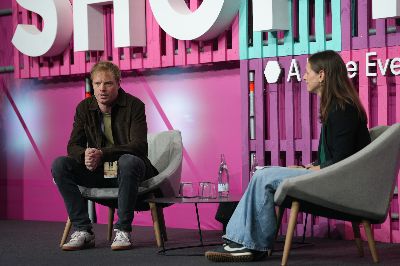
Speaking with Lawrence Roycroft, Vice President EMEA at KIBO Commerce, at NRF Europe in Paris, Eric Meulien, General Manager, Digital Retail at Al-Futtaim, explained how that principle has allowed the group to scale its e-commerce operation without repeatedly rebuilding the foundations underneath it.
The transformation began as a response to Covid. Five years on, it is becoming the infrastructure for something much bigger.
From Covid to Infrastructure
Al-Futtaim is fundamentally a physical retail business, which made the closure of stores during the pandemic a particularly important turning point.
Meulien said Covid forced the company to look at e-commerce as a new channel and invest heavily in digital capabilities across its brands.
But Al-Futtaim did not want to build only a website. From the start, the ambition was a centralised system that integrated the customer-facing e-commerce front end with order management behind it. Its business model is highly dynamic, with fulfilment from warehouses and stores as well as click and collect, so a strong order management system was essential.
That decision would become increasingly important as the number of digital storefronts grew.
Shared Underneath
The difficulty with centralisation is that Al-Futtaim cannot make every brand look the same. Its brands cover almost everything from home furnishings to beauty and fashion, and each has a distinct identity and specific requirements.
Al-Futtaim therefore adopted an atomic design approach, built on microservices. Rather than building every storefront independently, the team created reusable components, or widgets, that can be branded differently while working in the same way everywhere. Al-Futtaim took charge of the front end, while KIBO manages the back end.
Five Things Friday
Five useful signals from the people shaping global retail. Every Friday.
Each widget can be reused, rebranded and translated into local languages, which Meulien said are very important. But underneath, the code, approach and architecture stay the same. That, he said, enabled a very quick rollout across markets and brands.
It is a deceptively important distinction. Al-Futtaim standardised the infrastructure without standardising the customer.
One Backbone, 30 Experiences
The strategy soon expanded beyond websites.
Al-Futtaim quickly realised that mobile apps would be particularly important in its Asian markets. Instead of building a separate foundation for them, the business ran its apps from the same backbone as its websites, with all APIs shared across platforms.
Meulien said Al-Futtaim now runs around 30 digital experiences from the same code base and the same order management system. His teams work in a single system, while customers see what looks like 30 different experiences, in different languages and under different brand logos.
That is where composable architecture becomes commercially relevant. The benefit is not that the technology sounds modern. It is that the business does not have to rebuild itself every time it wants to grow.
It also lets Al-Futtaim respond to its internal clients. Meulien works with around 10 brand stakeholders, each effectively an internal client, and they sometimes change their minds. A brand might decide it does not need click and collect, then ask for it a month later because a competitor offers it. Because order management is fully integrated, the capability is already built in, and the front end can switch it on brand by brand as needed.
Weeks, Not Months
The early stages were not fast.
Meulien said the first 18 months were challenging, as the internal team learned the platform, its back end and how to optimise it. Close engagement with KIBO helped, including direct access to its product owners and architects and joint work on the product roadmap.
Then repetition began to pay off. After the third site, the team started to understand how to work faster and better.
At the time of NRF Europe, Meulien said, Al-Futtaim had just launched five Marks & Spencer websites in two months. A new website can now go live in roughly two to three weeks, with new brands moving at a similar pace thanks to the design system library.
That library matters for another reason, he added. AI tools can read a well-structured design system much faster than other architectures, which is already helping the team move more quickly.
That is a very different kind of digital advantage from having the most visually impressive website. It is organisational speed. Once the underlying architecture is reusable, launching another market or brand becomes less like starting a technology project and more like configuring an existing operating system.
The results show in the numbers. Meulien said Al-Futtaim has almost doubled its e-commerce business year on year for the past several years.
No Replatforming
There is another number that makes the architecture notable: zero.
Asked how many times Al-Futtaim had needed to replatform in the past five years, Meulien answered simply: "None." Nor is it planning to, because the platform is flexible enough to scale without repeating work.
That matters because replatforming can consume enormous amounts of capital, management attention and technical capacity without creating anything the customer immediately notices. Avoiding it allows more investment to go towards new capabilities rather than reconstruction.
KIBO describes its platform as modular and MACH-certified, combining e-commerce and order management while allowing capabilities to be added independently. Roycroft said that approach means new functionality can be added microservice by microservice without disruptive upgrades.
But Meulien made clear that the technology architecture was not the hardest part of the transformation. The hardest part was the information flowing through it.
The Data Problem
Asked about the biggest challenge of the transformation, Meulien did not point to technology, people or processes. He said data.
Al-Futtaim receives product information from multiple suppliers and brands in different formats, and its quality varies considerably. Some brands provide highly developed data, while others provide far less.
Yet e-commerce, CRM and marketing all depend on that information. Al-Futtaim therefore has a dedicated team that translates and enriches the data in-house, then augments it using new technologies such as AI.
That job is becoming more important because AI is changing what counts as useful product information. Traditional e-commerce was built around attributes such as size, colour, material, dimensions and price. AI shopping agents can ask questions those fields were never designed to answer.
Questions, Not Specifications
Meulien called product data enrichment one of his largest projects, and what Al-Futtaim is doing with it is one of the most interesting parts of the transformation.
The group now asks AI agents on platforms such as Gemini and ChatGPT to grade the quality of its product data against what they expect to find. From the results, it builds a map of the information missing to answer customers' specific questions.
The shift is subtle but profound. Al-Futtaim is moving away from specification data towards the solutions and questions customers are actually asking about.
Meulien gave fabric as an example. Customers ask how to care for a garment, or whether it might scratch around the neckline in a humid climate. Those are practical questions, and traditional product specifications will not answer them.
Al-Futtaim therefore uses generative AI to draft the answers, validates them with brand partners and suppliers, and adds them to its catalogue, changing its APIs to capture the new attributes. It is also working out how to use those attributes to improve recommendations and personalisation.
The work is already paying off. Meulien said the enriched data is helping Al-Futtaim's websites rank in organic search and, specifically, in generative AI search. "It does work, but it's a big job," he said.
This is where the transformation starts to look very different from the project that began during Covid. Al-Futtaim originally needed infrastructure capable of selling products online. Now it needs infrastructure capable of explaining those products to machines acting on behalf of customers.
Data Before Interface
Retail's conversation about agentic commerce often starts with the interface: shopping assistants, chatbots, AI search and automated baskets.
Al-Futtaim's experience suggests the harder work happens underneath. An AI agent cannot make a useful recommendation if the product catalogue lacks the information needed to answer the question.
A customer can infer a great deal from a photograph, and an experienced store employee can draw on product knowledge. But an agent expected to make or narrow a decision needs structured, reliable context.
That makes product data strategically important in a way that may not have been obvious when e-commerce systems were first designed. Agentic commerce is turning product information from a catalogue requirement into a reasoning layer.
Retailers with fragmented, inconsistent or shallow product data may find their AI ambitions constrained long before they reach the interface.
Built In-House
Meulien said Al-Futtaim's adoption of AI started slowly, but has accelerated over the past six months. The group now has a clear vision built around two areas. In the back office, AI should keep teams lean while expanding what they can do. At the front end, it should help the business keep pace with what customers expect.
Al-Futtaim is not relying entirely on external providers to get there. Meulien said the group has built its own AI agents and shopping assistants in-house.
Its headless architecture means it can plug in best-in-class tools for recommendations, site search, CRM data collection and loyalty, alongside those assistants. The group tests and learns, keeping only the best performer in each function. Roycroft noted that Meulien works with more than 30 technology platforms across his estate.
That reflects one of the central advantages Al-Futtaim sees in headless, API-first commerce. The front end is likely to change faster than the operational infrastructure underneath it, so the two should not be locked together unnecessarily.
Losing the Cart
The logical endpoint could look radically different from today's e-commerce website.
Meulien said Al-Futtaim is experimenting with agentic experiences and looking at how to bring the shopping cart directly into search. His goal goes further: he wants to get rid of the shopping cart altogether, and the team is testing how to achieve that over the next year or two.
That would be a significant change in e-commerce design. For decades, the online journey has followed roughly the same structure: search or browse, open a product page, add to cart, keep browsing, review the cart and check out.
Agentic commerce challenges that sequence. If the system understands intent, product information, availability, customer history and preferences, the journey can collapse.
A customer could simply describe what they need. The system could then identify the right products, refine the choice, assemble the order and move straight to fulfilment.
The shopping cart stops being a destination, because the conversation itself becomes the process of building the basket.
Fifteen Minutes
AI is not the only force reshaping Al-Futtaim's front end. Speed is another.
Meulien said customers in Dubai can now get almost anything delivered within around 15 minutes, an expectation he noted that markets such as the US do not yet face. Speed, he said, helps acquisition as much as conversion.
Offering that speed is not simply a logistics problem. It changes the digital journey. To guarantee delivery, the retailer needs to know where the customer is and fulfil the order from a location within roughly three kilometres.
As a result, Al-Futtaim is rethinking its entire front end around location and fulfilment. Meulien said this is exactly where a headless architecture pays off, because the customer journey can be redesigned without touching the systems underneath.
The storefront can no longer behave as though every customer sees the same inventory from the same network. Location becomes part of merchandising.
The POS Barrier
For all the work completed online, e-commerce is still a small share of Al-Futtaim's total business. The next priority, on its roadmap for the coming years, is integrating online and offline more closely.
Meulien identified point-of-sale systems as the next major barrier. Al-Futtaim is ready to connect its content management, CRM and one-to-one personalisation with store POS. But upgrading POS across a large physical estate is a big project, and he expects it to be a challenge across the region and beyond.
Once that gap is closed, Meulien said, Al-Futtaim will have a full 360-degree ecosystem to build on.
It is a recurring problem in omnichannel retail: the most visible innovation happens at the front, while the hardest integration happens underneath.
The Payments Problem
Asked what had proved unexpectedly difficult, Meulien pointed not to e-commerce or order management, but to payments.
Operating across so many countries means working with a wide range of local payment methods. Meulien said payments had caused a lot of headaches over the past couple of years, and called payment integration the most painful aspect of launching. E-commerce platforms do not provide it either, so it has to be solved separately.
He said Al-Futtaim was now reaching the point of having found the right solution. On 22 September, shortly after NRF Europe, the group announced a strategic partnership with Juspay to provide payment orchestration across 50 brands in 12 markets, with the first brand scheduled to go live that same month.
The system gives the group central control while letting each country and brand keep its own payment set-up and checkout experience. Al-Futtaim also says the partnership lays the foundation for agentic commerce, with AI agents eventually able to initiate and complete payments on customers' behalf.
The timing reinforces Meulien's point. International e-commerce rarely struggles because a retailer cannot build another homepage. The complexity builds up in the infrastructure customers barely see: payments, data, orders, inventory, localisation and fulfilment.
What Not to Standardise
Al-Futtaim's transformation is ultimately a study in controlled standardisation.
The group does not want 30 completely independent technology estates. But it cannot flatten dozens of customer experiences into one generic storefront either.
So it standardises what customers do not need to see: the architecture, APIs, order management, reusable design components and governance. It then builds flexibility where customers do notice, in brand identity, language, product experience, local payment methods, fulfilment and customer journeys.
That separation is what allows scale without making every brand feel identical.
It is also why Meulien's advice to other retailers begins with simplicity. Al-Futtaim uses design thinking for UX and UI, and looks for robust products that integrate easily with other systems. With SAP running in the back end, it needs tools that plug in quickly through APIs.
Above all, he said, retailers should decouple the front end from the back end. The front end will evolve faster, so it needs flexibility, while the back end needs to be a really solid foundation.
Built for Change
Asked whether transformation ever really ends, Meulien reframed it as evolution.
Al-Futtaim works to a roadmap extending two or three years ahead, and tries to influence its partners' roadmaps while learning from their other customers. But nobody knows exactly what the future holds, so the group applies design thinking and critical thinking that allow it to start from scratch whenever it needs to. Building e-commerce, he said, is a transformation that he does not think will ever end.
What stays constant is the method: design thinking, governance and strict discipline about what the team does and does not do. Every investment is measured on its return and its impact on the customer, with the aim of removing friction from the journey rather than adding it.
That may be the most useful way to understand Al-Futtaim's journey. The achievement is not that it built a platform capable of supporting today's e-commerce model. It is that it tried to build one that would not need replacing every time the model changed.
Over five years, apps have become more important, international expansion has added localisation, ultra-fast delivery has changed how the front end understands location, and AI is reshaping both discovery and product data. The next shift is unlikely to be the last.
Retail technology transformations often promise a finished future state: build the new platform, complete the migration, launch the site and move on. Al-Futtaim's experience points to a different objective, which is to build the business so it never has to start again.
The architecture is not valuable because it predicts the future. It is valuable because it assumes the future will change.
Al-Futtaim began this transformation because its stores suddenly closed and e-commerce became essential. Five years later, it is preparing for customers who may expect a product in 15 minutes, ask an AI agent to choose it for them and never see a conventional shopping cart at all.
The specific technologies will keep changing. The competitive advantage is being able to change with them without rebuilding the business every time.
Sources
This article is based on RetailNews.ai's reporting from Eric Meulien's conversation with Lawrence Roycroft of KIBO Commerce at NRF Europe in Paris. Al-Futtaim's brand portfolio was checked against the group's own brand pages. Details of the Juspay partnership were checked against Al-Futtaim's 22 September 2026 announcement.
Related coverage

E-Commerce
GLS and Geopost plan German parcel joint venture
Nov 20, 2026
E-Commerce
Pinterest adds Compare and Wishlists for holiday shoppers
Nov 17, 2026
E-Commerce
Zalando opens its app to other online shops' products
Nov 6, 2026
E-Commerce