ASOS, Nestlé, L'Oréal: People Make AI Work in Retail
Retail success with AI requires prioritizing human integration over technology, as seen with ASOS, Nestlé, and L'Oréal, which find human-centered approaches yield up to 5x higher valuation multiples and significant productivity gains.
- 1Investors value AI's retail potential at nearly five times previous transitions, with productivity gains forecasted between electricity's impact and triple that, highlighting the strategic importance of human-AI
- 2ASOS, Nestlé, and L'Oréal emphasize integrating AI by building 'co-intelligence' teams and focusing on human adoption through initiatives like Nestlé's NesGPT, which has over 100,000 users, and ASOS's 1,000 citizen-developed agents.
- 3Successful AI deployment in retail, such as Nestlé's virtual sales assistant reducing admin by 30-40%, hinges on addressing human resistance and focusing on organizational redesign rather than just tech rollout, as highlighted by L'Oréal's experience with the Beauty Genius tool and Nestlé's B2B platform.
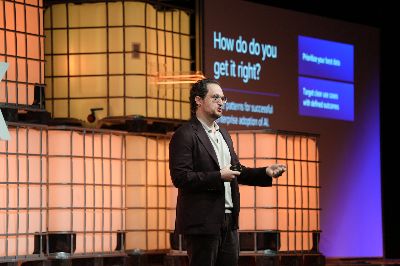
Jordan Berke, Founder and CEO of TOMORROW, opened his session at Shoptalk Europe with a number designed to make the room sit up. Investors are currently valuing the potential of AI at almost five times the average of the last five major transitions retail has been through, including e-commerce itself. Economists at the London School of Economics and the OECD put the likely productivity gain at somewhere between the impact of electricity on the low end and two to three times that on the high end.
"We are living through a once-in-a-century moment," Berke told the audience.
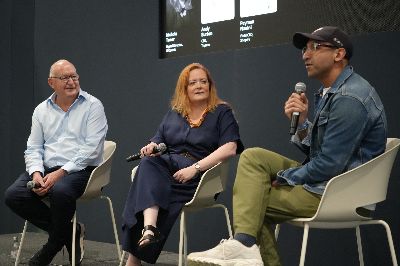
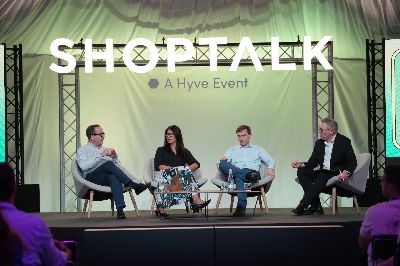
But the most useful part of his session came after the data. Berke welcomed three executives to the stage - Przemek Czarnecki, Chief Technology Officer at ASOS, Jordi Bosch, Global Head of Sales & Customers at Nestlé, and Beyza Kapu, Global Director, Ecommerce Tech & Data Analytics at L'Oréal - for a conversation about what co-intelligence, Berke's term for combining human judgement with AI's processing power, actually looks like inside three very different organisations.
Three Companies, Three Starting Points
Berke had just walked the audience through three archetypes drawn from a study of 100 retailers globally: Walmart's all-in, top-down transformation, Kroger's tightly ROI-focused approach, and Woolworths' more organic, slower-moving journey. He asked each panellist which pattern, if any, matched their own experience.
Czarnecki was direct. "Parts of the approach resonate, but the approach at ASOS is completely different," he said. ASOS has focused on two things simultaneously: putting AI tools in front of literally every employee, and making specific, large bets in areas like the contact centre and the creative process, rather than following any single playbook wholesale.
Bosch recognised elements of all three archetypes inside Nestlé. The organic pattern shows up in how broadly AI tools have spread, with more than 100,000 colleagues now using Copilot daily through an internal version of ChatGPT called NesGPT. The more financially disciplined pattern shows up when it comes to larger investment decisions, where Nestlé wants a solid business case before committing serious money. But the archetype that best captures Nestlé's overall direction, he said, is the all-in, human-centred transformation, anchored by a new internal capability called the Nestlé AI Factory, which supports functions end-to-end from initial design through to full industrialisation.
Kapu described a similar blend at L'Oréal, but with a clearer sense of sequence. The company started in an organic place, with different functions, categories and regions experimenting at their own pace. That had real value, she argued, because it revealed where genuine appetite and genuinely useful use cases existed, rather than where leadership assumed they would be. But organic experimentation hits a ceiling: pockets of strong work that never connect to each other, and local teams optimising in isolation rather than systematically. That is what pushed L'Oréal toward something closer to the Walmart model, where engaging with AI stops being optional for any function. "I think there was value in it," she said of the earlier organic phase, "because it was a space for the team to play with it, to experiment, to digest it."
Why ASOS Stopped Building Disconnected Agents
Czarnecki gave the most detailed account of how ASOS's thinking actually evolved, and it is a useful cautionary tale for any organisation currently building an AI use case list.
"I think we all started, at least a year ago, by creating a list of use cases," he said. "And what do you do next? You prioritise them and try to find which ones have the biggest impact." The problem, ASOS discovered, was what that approach produces: a set of disconnected agents scattered across the organisation. "It's a bit like a football team where nobody is passing the ball to anybody else. You have these isolated players, these isolated agents, providing some useful services but not really increasing value across the enterprise."
The alternative ASOS built instead is what Czarnecki calls a hybrid organisation: reimagining entire teams, a new contact centre, a new merchandising and buying function, designed from the ground up around people and agents collaborating, with organisational design treated as seriously as the technology itself. As a concrete example, he described how the head of merchandising mapped out both an "organisation of today" and an "organisation of tomorrow," with agents embedded directly into specific fashion functions, handling tasks that previously required dedicated headcount, while merchandisers and buyers focus on the judgement calls that genuinely need a human.
What Actually Changed for a Salesperson at Nestlé
Asked what is genuinely different about being a salesperson or marketer at Nestlé compared with eighteen months ago, Bosch offered three specific examples.
The first is content. Work that used to take months to produce - product photography, titles, descriptions - now takes days, at a fraction of the previous cost, generated with generative AI. The more striking part, Bosch said, is that this AI-generated content is often outperforming what came before it, with better conversion and stronger organic sales, under appropriate supervision.
Five Things Friday
Five useful signals from the people shaping global retail. Every Friday.
The second is promotional planning. Tasks that used to require extensive manual analysis can now simulate hundreds of potential promotional scenarios in minutes, giving teams far more room to test ideas before committing.
The third, and the one Bosch said he is most proud of, is Nestlé's virtual sales assistant. Sales professionals across most companies, he noted, lose up to two days a week to administrative work, chasing numbers, compiling information, tasks that are necessary but add no real value. The virtual assistant cuts time spent on that work by 30 to 40%, freeing sales teams to reinvest that time directly in serving more customers.
When the Technology Is Ready Before the People Are
Berke asked the panel directly: has anyone seen a situation where the technology was ready and working well before the human organisation around it was prepared to accept it?
Kapu's answer was unequivocal. "Absolutely. I think this is common practice, not the exception," she said. "The resistance rarely comes from the technology. It comes from the human system around it." Digging into that resistance, she found it is rarely about capability. People sense that when AI starts making recommendations, it is implicitly making judgements about whose data matters, whose expertise is valued, and whose role will ultimately survive. "This is not a technology discussion," she said. "It's a human conversation." What works, in her experience, is organisations that take the anxiety seriously rather than dismissing it as irrational, creating space for teams to genuinely adapt rather than declaring a transformation and simply expecting compliance.
She offered L'Oréal's Beauty Genius tool, trained on more than 150,000 dermatologist annotations and extensive product data, as a concrete example. The bigger shift it produced was not in the consumer-facing algorithm itself, but in how internal teams started working. Once they could see the feedback loop in real time, they began restructuring how they wrote product content from the ground up, no longer writing purely for human readers but for machine readability too. They changed not because they were instructed to, but because they could see the results for themselves. The shift Kapu is now looking for across the organisation is teams moving away from asking whether they should use AI for a given task, and toward asking how to give AI the best possible input in order to get the best possible output.
Bosch shared a comparable story from the Philippines, where Nestlé deployed a B2B ordering platform two years ago, allowing small retailers to order around the clock through an app rather than through a human sales representative. On paper it looked like an obvious win for everyone involved, freeing reps to spend time on higher-value merchandising work instead. In practice, both the reps and the customers initially assumed the platform existed to replace the sales team, and found every reason not to use it, citing network issues, technical problems, anything but the real concern. Only once Nestlé explicitly brought people along on the journey, explaining that the platform was there to amplify the sales team rather than replace it, did adoption take hold.
Czarnecki's version of the same lesson played out at ASOS in the gap between giving people a tool and getting them to actually use it well. Simply rolling out Copilot to everyone took real investment in training before adoption genuinely took off. The more interesting shift, in his telling, has been watching employees move from consumers of AI to creators of it. "So many people are proficient at chatting with AI tools," he said, "but only a handful can write an agent. That's the difference between being a consumer of AI and being a creator of AI." ASOS now has close to 1,000 agents built by what Czarnecki calls citizen developers, non-engineering employees. Not all of them are useful. Many are essentially tests. But a meaningful number are genuinely being used by colleagues day to day, which Czarnecki sees as proof that the right environment and the right incentives turn AI into something people want to use to augment themselves, rather than something to fear.
The Gap Between Leaders and Everyone Else Is Widening
Berke pushed Bosch on which retailers in Nestlé's own account base are pulling ahead, and what that is doing to their performance and partnership with Nestlé.
Digitally native retailers like Amazon and Alibaba carry a natural advantage, Bosch said, because transformation and experimentation are simply part of their DNA, embracing AI quickly both internally for productivity and externally through tools like virtual shopping assistants. But the more remarkable transformation, in his view, is happening at traditional retailers moving fast despite their scale, with Walmart as the clear example: building a genuine digital ecosystem spanning stores, financial and banking services, drone delivery, retail media, and now AI deeply embedded throughout, with agents supporting employees, agents supporting vendors, and Walmart's Sparky assistant supporting consumers directly.
Bosch believes this ecosystem model is where many retailers are heading, and it changes what Nestlé itself has to focus on. One priority is what he called agentic commerce readiness, making sure that when a consumer asks ChatGPT or Sparky for a recommendation on coffee or pet food, the answer they receive is accurate, trustworthy, and genuinely reflects what Nestlé and its retail partners offer. The industry used to talk about being channel-less, he said. Now the conversation is shifting toward being shopper-less, as AI agents increasingly become the ones doing the shopping on a customer's behalf. The second priority is connecting value chains directly, agents talking to agents across product catalogue management, claims and deductions, and forecasting, work Nestlé is already doing internally but sees as a much bigger opportunity once retailers and manufacturers connect their systems to each other.
Berke then asked Kapu a sharper version of the same question: will the agentic era let today's leading retailers extend their advantage, or will it democratise the playing field for mid-tier and smaller players?
"The gap between the leaders and the rest is widening faster than people realise," Kapu said. Digital natives have the infrastructure and the data, but just as importantly, they have the culture and the internal teams willing to change quickly. "It's not about who has the best AI tools," she said. "It's about who has the environment and ecosystem around it that makes the tool actually deliver." Her broader framing was pointed: AI does not transform organisations. Organisations that are already ready for AI are the ones that get transformed by it. Brands, she argued, have a genuine role to play in that readiness, not just by producing strong product content but by providing consistent, structured, machine-readable data that lets the entire ecosystem function. The winners, in her view, will be the ones who understand that the shelf of the future is not a place but a layer, co-created between brand and retailer, and built on genuinely machine-readable foundations.
Berke summarised the implication bluntly: the strongest retailers in 2026 have the opportunity to extend their lead significantly, and the risk for anyone without strong foundations already in place is correspondingly larger.
Managing the Anxiety, Not Just the Technology
Berke closed by returning to the human side of the transformation directly, referencing Walmart's public commitment not to reduce headcount for three years despite the business growing 20% over that period, framing AI instead as headcount rotation rather than headcount reduction. He asked Czarnecki how ASOS manages that same anxiety, the quiet fear among employees that there may not be a place for them going forward.
"It's mostly about creating a mindset of curiosity, and using the language of augmentation," Czarnecki said. A gloomy framing centred on AI replacing jobs does not unlock the value a company can actually get from the technology. The more useful question for employees to ask themselves is whether AI can augment their job, remove tasks they genuinely dislike, or accelerate work that needs to happen for the business to stay competitive. Shifting the narrative toward augmentation, paired with real, visible success stories of employees and teams becoming more effective by working alongside AI, changes how people experience the whole transformation.
Asked for the one piece of advice each would take back to their own organisations, Bosch did not hesitate. "Change management," he said. "Never, ever underestimate the importance of change management." In his view, it is by far the most important factor in the entire AI journey.
Kapu's answer was closely related. "Fix the ways of working before fixing anything else," she said. Most companies already have the content, the technology, the people, and the data they need. What they lack is a coherent operating system that gets teams genuinely working together around the actual challenge. Without that, even good AI initiatives produce small, isolated improvements that get absorbed and lost somewhere else in the organisation rather than compounding into something larger.
Czarnecki's closing note was about the individual rather than the organisation. "Learning AI is a full-time job," he said. "This is the time to learn, the time to upgrade your skills, to become a creator of AI, not only a customer of it."
Related coverage

Technology
Amazon Alexa+ Tablets Run Android, Sell at Target and Best Buy
Oct 11, 2026
Technology
Cybersecurity Is Now a Board Issue, Not Just a Technology Problem
Sep 8, 2026
Technology
Jabra Bets on Voice as the Gateway to AI for Retail's Frontline Workers
Aug 17, 2026
Technology