Holden Bale: 88% of Retailers Have Deployed AI, Only 6% Can Prove It Made Money
Holden Bale, Global Chief Strategy Officer at Merkle, told Shoptalk Europe that 88% of enterprises have deployed AI since the end of last year but only 6% can draw a straight line to EBITDA value, an 82-point gap he attributed to performance being mistaken for execution. He laid out five patterns that separate real value from activity: starting where the data advantage is strongest, tying each initiative to a time-bound ROI target, redesigning the work itself, engineering trust in the model, and matching the use case to the user's altitude.
- 1Merkle's research across 100 enterprises with revenues over a billion dollars found 88% have deployed at least one AI application since the end of last year, but only 6% can draw a straight line to EBITDA value.
- 2Holden Bale identified five patterns that separate real AI value from activity: prioritising your strongest data, tying every initiative to a time-bound outcome, redesigning the work itself, engineering trust into the model, and matching the use case to the user's altitude.
- 3Bale predicted that by early next year, 100% of employees at sophisticated retail organisations should have role-ready conversational insight tools, and the time from insight to published content should compress by 50 to 70%.
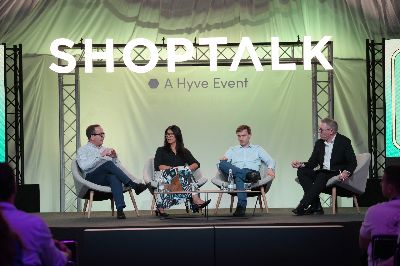
Holden Bale opened his session at Shoptalk Europe in Barcelona with a joke about being brave enough to talk about AI at a business conference, as though anyone in the room had the option to skip it. Then, as Global Chief Strategy Officer at Merkle, he spent the next half hour making a case considerably less comfortable than the joke suggested: most of what retail currently calls AI transformation is performance, not execution, and the gap between the two is enormous.
"Eighty-eight percent of enterprises we surveyed have identified and implemented at least one AI application since the end of last year," Bale told the audience. "Six percent can draw a straight line to EBITDA value. That is an enormous gulf."
That gap is the entire premise of what Merkle, dentsu's data-driven, experience-led transformation consultancy, has been studying. The data Bale shared was drawn from live client work and a survey of 100 enterprises with revenues over a billion dollars, conducted at the end of last year. None of it was hypothetical.
Four Forces Pulling Retail Leaders in Opposite Directions
Bale began by naming the pressures that, in his telling, define what it currently feels like to run a retail business at the executive level.
The first is profitability, and the shift back to caring about it. "Anybody who got an MBA from Stanford or INSEAD or Wharton between 2014 and 2022 was not taught to care about profit at all," he said. "All they thought about was growth." That changed after COVID, when markets collectively decided profitability mattered again, and it has remained the dominant pressure on C-suite leaders ever since.
The second is the sheer uncertainty surrounding AI itself, what Bale called "the cone of uncertainty," in which much of the promised benefit remains speculative and a great deal of the visible activity in the market is, in his word, performative.
The third is workforce fatigue, a factor Bale argued is dramatically underdiscussed given how consistently it surfaces in Merkle's data. He asked the room how many people had been through an organisational change in the last twelve months. Every hand went up. He asked how many had been through multiple. Most stayed up. People are exhausted by constant transformation, returning to office mandates, and restructuring, and that exhaustion directly affects how willing they are to adopt yet another new system.
The fourth was political and macroeconomic instability. Here Bale made a wry aside rather than a full argument, joking that as an American he was not equipped to unpack European political dynamics in detail, and moved on.
Bale was candid that these forces sit in direct tension with each other. Leadership is being told to deliver profitability while also being told that AI represents a once-in-a-generation technology shift requiring sustained investment. Meanwhile the workforce expected to execute that shift is tired, and the broader economic and political backdrop offers no stability to plan against. "This is the number one question you're asking," he said. "This is the number one question your boss is asking you."
The Goldilocks Problem
Bale's central diagnosis for why so many AI initiatives fail to produce measurable value was what he called the Goldilocks problem, organisations stuck between two failure modes, neither of which is the right temperature.
On one side is paralysis by analysis: endless planning, three-year roadmaps built with major consulting firms, conference attendance, and white papers, with no actual deployment happening underneath all the activity. On the other side is the opposite failure, an explosion of small, disconnected initiatives with no coordinating strategy. Bale compared this directly to the early years of cloud computing, when engineering teams suddenly had powerful new self-service tools and finance departments lost control of spend almost overnight. "AI is to all of your employees what cloud was to just your technology department," he said. His illustration was deliberately absurd: a junior employee somewhere in the building independently building an enterprise-grade system that nominally serves a handful of users, quietly burning through budget and tokens with nothing measurable to show for it.
The businesses that find the middle ground, neither frozen nor scattered, are the ones converting investment into actual value.
Five Things Friday
Five useful signals from the people shaping global retail. Every Friday.
Five Patterns That Separate Real Value From Activity
Drawing on Merkle's research across 100 large enterprises, Bale identified five specific patterns shared by the organisations actually closing the gap between AI adoption and measurable return.
The first is starting wherever an organisation's data advantage is genuinely strongest, not wherever AI seems most exciting. A retailer with deep supply chain and logistics data should start there. One with rich merchandising and product data should start there instead. A multi-brand retailer with a loyalty programme spanning 75 million consumers has a different kind of advantage entirely, a dense first-party data graph that most competitors simply cannot replicate. "Most of your ROI is going to come from where you have differentiated data," Bale said.
The second is tying every initiative to a clearly defined, time-bound outcome, not a vague goal. Bale pushed the room to imagine being asked a direct question about any AI initiative they were running: what is the goal in three months, expressed as a confidence interval of ROI or business value, and what is the goal nine months after that. If an initiative is not meeting its defined target, the discipline required is to kill it and redirect the resources, not let it continue indefinitely on the strength of sunk cost.
The third is redesigning the actual work itself rather than simply layering new technology on top of an unchanged process. Bale drew the comparison to enterprise resource planning implementations, asking how many people in the room had lived through one that ran years over schedule and over budget. Every hand went up. "Nobody in the history of the universe has ever enjoyed an ERP implementation," he said. The same failure mode is currently being repeated with AI: tools handed to employees with no corresponding redesign of how the work actually gets done, and the predicted benefits failing to materialise as a result.
The fourth is engineering trust deliberately, not assuming it will follow automatically from a good tool. A merchant running a demand forecast who cannot understand the logic behind an AI's recommendation will never act on it. A site merchant generating a product description who does not know what source data the AI pulled from will not trust the output enough to use it without rewriting it from scratch. Visibility into how an AI system reaches its conclusions, Bale argued, is not a nice-to-have. It is the precondition for adoption.
The fifth is altitude, recognising that the right AI use case looks completely different depending on seniority and role. Bale described a retailer whose first internal chatbot use case was something deceptively modest: digitising the standard operating procedures that only a fifteen-year veteran store manager actually remembered, like what to do if the power goes out, so that seasonal staff with high turnover could access that knowledge instantly. That is the lowest altitude. The highest altitude is a CEO with an app they can open and simply ask a business question, same-store sales comparisons, the performance of a specific campaign, how a particular market is trending, and get a direct conversational answer. "Those kinds of conversational insights," Bale said, "are things I would expect every single person in this room, based on your level of seniority, to be able to access in the next six months. If you can't, you need to go back and reassess your roadmap, and ask why that's not the case."
Proof, Not Pilots
Bale returned repeatedly to a single distinction: adoption driven by proof rather than adoption driven by pilots.
"Can you prove it works, not gut feel," he said. "Three months, here's our goal. Nine months, here's our goal. Can you show that in a case? Can you prove that someone's job got better?" He was explicit that logging into a tool does not count as a success metric. "If your success metric for a tool is somebody logged into it, God be with you."
He borrowed a line from basketball coach John Wooden to summarise the failure mode he sees most often: never mistake performance for execution. A great deal of what currently passes for AI transformation in retail, in Bale's assessment, is exactly that, visible activity that photographs well and means very little when you actually ask an employee whether their job changed for the better.
The examples of genuine execution he offered were concrete rather than aspirational. A connected AI application built for a complex B2B company, where training a new customer service representative used to take a full year because of catalogue complexity, now optimises the equivalent of 55 full-time employees' worth of work, handling 6 million emails and 650,000 requests for quotes, freeing those employees to focus on higher-value service instead. He also pointed to generative models now being used to identify which stores in a large fleet need operational intervention, moving well beyond static dashboards into something that actively directs where attention should go.
What Bale Expects in the Next Six Months
Bale closed his portion of the session with specific, falsifiable predictions rather than directional generalities.
By early next year, he expects 100% of employees at sophisticated retail organisations to have access to some form of role-ready intelligence, conversational insight tools tailored to what their specific job actually requires. He expects a 50 to 70% reduction in the time it takes to move from insight to published content, the kind of compression that underlies what people mean when they talk about a content supply chain. And he was direct about the harder truth underneath both predictions: running a digital business is about to get more complicated, not less, with new touch points to manage and a search landscape already being fundamentally restructured by AI.
The throughline across all of it was the same discipline Bale opened with. AI adoption without a clear data advantage, a defined outcome, a redesigned process, engineered trust, and the right altitude is activity. It is not execution. And in Bale's assessment, the 82-point gap between the 88% of enterprises that have deployed AI and the 6% who can prove it worked is not going to close on its own. It closes only for the organisations disciplined enough to apply all five patterns at once, not just the ones that happen to be convenient.
Frequently Asked Questions
What is the key point of "Holden Bale: 88% of Retailers Have Deployed AI, Only 6% Can..."?
- Holden Bale, Global Chief Strategy Officer at Merkle, told Shoptalk Europe that 88% of enterprises have deployed AI since the end of last year but only 6% can draw a straight line to EBITDA value, an 82-point gap he attributed to performance being mistaken for execution.
Four Forces Pulling Retail Leaders in Opposite Directions - what does it mean?
- Bale began by naming the pressures that, in his telling, define what it currently feels like to run a retail business at the executive level. The first is profitability, and the shift back to caring about it.
The Goldilocks Problem - what does it mean?
- Bale's central diagnosis for why so many AI initiatives fail to produce measurable value was what he called the Goldilocks problem, organisations stuck between two failure modes, neither of which is the right temperature.
Five Patterns That Separate Real Value From Activity - what does it mean?
- Drawing on Merkle's research across 100 large enterprises, Bale identified five specific patterns shared by the organisations actually closing the gap between AI adoption and measurable return. The first is starting wherever an organisation's data advantage is genuinely strongest, not wherever AI seems most exciting.
Proof, Not Pilots - what does it mean?
- Bale returned repeatedly to a single distinction: adoption driven by proof rather than adoption driven by pilots. "Can you prove it works, not gut feel," he said. "Three months, here's our goal. Nine months, here's our goal. Can you show that in a case?
Related coverage

Technology
Cybersecurity Is Now a Board Issue, Not Just a Technology Problem
Sep 8, 2026Technology
Jabra Bets on Voice as the Gateway to AI for Retail's Frontline Workers
Aug 17, 2026Technology
From Products to Ecosystems: Nagarro's Vision for the AI-Powered Future of Retail
Aug 13, 2026Technology
NVIDIA's Vision for AI in Retail: Shopping Assistants, Digital Twins and the Rise of Physical AI
Aug 7, 2026
Jabra Bets on Voice as the Gateway to AI for Retail's Frontline Workers
Andrew Doyle, VP for Frontline Workers at Jabra, argues that voice is becoming the natural interface between retail associates and AI agents - and that audio quality decides whether those systems work on the shop floor.
Continue readingMore in Technology

🔍 Explore related coverage