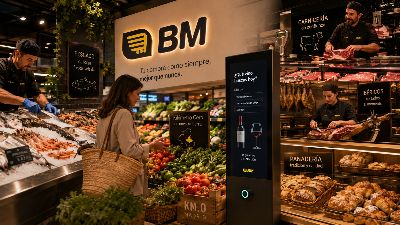
The World's Best Stores Are Converging Around One Idea
Echochamber founder Matthew Brown says the world's most innovative stores, from Lefties and HOFF in Madrid to Mecca in Melbourne and Printemps in New York, now compete on hospitality, community and experience rather than product or price.
- 1Experience has replaced product range and price as physical retail's strongest competitive advantage, with hospitality becoming the operating system of the best stores.
- 2Lefties shows value retail can deliver premium design at Primark price points, squeezing mid-market retailers that charge more for a worse experience.
- 3Technology is receding into the background as infrastructure, while community programming and cultural events become measurable commercial strategies.
Matthew Brown's latest selection of the world's most innovative stores reveals a clear direction for physical retail. The winners are no longer competing on products alone. They are competing on emotion, hospitality, community and experience.
For years, the retail industry has debated whether physical stores still matter.
The better question today is different.
What should a store actually do that a website cannot?
According to retail futurist and Echochamber founder Matthew Brown, the answer has never been clearer.
After nearly 27 years travelling the world documenting retail innovation, Brown believes physical retail is entering one of its most creative periods. Stores are becoming more immersive, more experiential and more emotionally engaging, regardless of whether they sell luxury fashion, groceries or value apparel.
"Every year I keep thinking that retail just cannot get any better," he told Alex Rezvan on The Retail Podcast. "And every year I'm happily proved wrong."
His latest selection of the world's most innovative stores is not simply a list of beautiful spaces.
It offers a snapshot of where global retail is heading.
And the message is remarkably consistent.
The retailers winning today are no longer asking how to sell more products.
They are asking how to create places people genuinely want to spend time in.
Five Things Friday
Five useful signals from the people shaping global retail. Every Friday.
Experience Has Become the New Competitive Advantage
Retailers once differentiated themselves through product selection.
Then price became the dominant battleground.
Today, experience is emerging as the industry's strongest competitive advantage.
Brown argues that every year retailers become more creative, not because they want to, but because they have to.
Consumers now compare physical shopping with the convenience of e-commerce, the entertainment of social media and the hospitality standards of hotels and restaurants.
Simply offering products is no longer enough.
Stores must give customers a reason to visit.
That shift can be seen across every category represented in Brown's global selection.
Geography No Longer Defines Retail Leadership
One of the clearest changes is where innovation is happening.
Brown believes Asia continues to lead the industry, with China, Seoul and Bangkok producing some of the world's most creative retail environments.
What is perhaps more surprising is his view of Europe.
Madrid, he argues, has quietly become one of the continent's most exciting retail cities.
"It's a kind of quiet, lovely city," he said. "But actually, I think Madrid has really accelerated in standing."
Much of that momentum has been driven by Inditex, which has transformed the Spanish capital into a testing ground for flagship concepts before expanding ideas internationally.
From Zara Man to the new Zara Serrano, Madrid is becoming a living laboratory for modern store design.
Great Ideas Travel Faster Than Categories
One of Brown's most interesting observations is that retail innovation no longer belongs to individual sectors.
The strongest ideas move freely between fashion, beauty, food and home.
A supermarket can learn from a luxury boutique.
A footwear brand can borrow from hospitality.
A beauty retailer can become an education hub.
"It doesn't really matter what you're selling and at what price point," Brown said. "You still have to create amazing surprise and delight to be at the top of the pile in retail."
Consumers no longer separate their expectations by category.
They expect every shopping experience to be intuitive, inspiring and memorable.
The retailers succeeding are often those looking outside their own industry for inspiration rather than benchmarking direct competitors.
Hospitality Is Becoming Retail's Operating System
Perhaps the most obvious pattern across Brown's top stores is the growing influence of hospitality.
Retailers are increasingly designing destinations rather than shops.
Melbourne's Mecca flagship on Bourke Street combines beauty with a café, hair salon, event and education spaces, and an in-house naturopath, all housed within a beautifully restored heritage building.
Madrid's HOFF flagship, a 700-square-metre space on Calle Velázquez founded by Fran Marquina, integrates art installations, a coffee collaboration bar, a champagne and charm bar, and an upper floor of co-working and event rooms where the brand's management team work alongside customers.
New York's Printemps, which opened at One Wall Street in March 2025 and describes itself as a hospitality project rather than a department store, reinvents the retail experience through a series of intimate rooms, each with its own personality and a distinct hospitality element, inside a protected heritage building in the financial district.
The products remain important.
But they are no longer the entire experience.
Retailers increasingly recognise that customers visit stores for inspiration, discovery and connection as much as they do for transactions.
Value Retail Is Looking Premium
One of the strongest commercial lessons comes from Lefties, Inditex's value fashion chain.
Brown describes the Lefties flagship as incorporating not only fashion but home, a florist, a Bombón Boss café, a slide between floors and RFID smart fitting rooms, all at Primark price points.
"This is Primark price points but with premium-looking design and fantastic experience," he said.
Brown describes this phenomenon as the "push for posh".
Value retailers are investing heavily in customer experience while maintaining aggressive pricing.
Lefties is now announcing a major expansion across Europe, which Brown believes will have far-reaching consequences.
"You just cannot have a mid-market proposition at higher prices than this if you're gonna offer a worse shopping experience," he said. "This is probably the most significant of the case studies from a wider retail perspective."
That creates significant pressure for traditional mid-market retailers.
If shoppers can enjoy premium environments while paying value prices, the middle ground becomes increasingly difficult to defend.
This trend is likely to reshape far more than fashion.
It raises expectations across grocery, home improvement, electronics and general merchandise.
Customers increasingly expect every store to feel premium, regardless of the price point.
Technology Has Become Almost Invisible
Interestingly, technology is no longer the headline.
It has become infrastructure.
Brown highlights RFID-enabled fitting rooms, automated hanger replenishment and frictionless checkout, but these innovations are notable precisely because they stay in the background.
The best technology removes effort.
It does not demand attention.
Retailers appear to be moving away from technology as spectacle and towards technology as service.
Customers remember how easy the experience felt, not necessarily which systems powered it.
Community Is Becoming a Commercial Strategy
Another recurring theme is the growing importance of community.
HOFF's flagship demonstrates this particularly well.
The store hosts regular events and collaborates with independent local businesses, currently running a pop-up from Luna & Wanda, a celebrated Madrileño cheesecake brand from the Justicia neighbourhood, in its coffee area at the front of the store.
The physical store becomes part workplace, part cultural venue and part retail destination.
This reflects a broader shift.
Retailers are no longer measuring success only by transactions.
They are measuring how often customers choose to return, participate and engage with the brand beyond making a purchase.
The Store Is Becoming the Brand
Looking across Brown's selections, one conclusion stands out.
The physical store is increasingly becoming the brand's strongest expression.
Products can be purchased almost anywhere.
Digital experiences can often be replicated.
A memorable physical environment is much harder to copy.
It communicates a retailer's values, personality and ambition in ways that advertising rarely can.
That is why companies continue investing heavily in flagship stores despite the continued growth of e-commerce.
The store has evolved from a sales channel into a strategic brand asset.
Retail's Future Will Be Measured in Memories, Not Square Metres
Matthew Brown's annual ranking is ultimately less about identifying the world's most beautiful stores than understanding why they succeed.
The best retailers are no longer competing to build bigger stores.
They are competing to build better experiences.
Whether it is a value fashion chain in Madrid, a beauty destination in Melbourne, a premium food retailer in Dublin such as Donnybrook Fair, or a reinvented hospitality concept in New York, the same principle applies.
Customers have countless ways to buy products. What Brown's selections reveal is that the retailers winning are not the ones making it easier to purchase. They are the ones making it harder to leave.
The future of stores, as Brown sees it after nearly 27 years of looking, belongs to those that create experiences worth leaving home for in the first place.
Frequently Asked Questions
What is the key point of "The World's Best Stores Are Converging Around One Idea"?
- Echochamber founder Matthew Brown says the world's most innovative stores, from Lefties and HOFF in Madrid to Mecca in Melbourne and Printemps in New York, now compete on hospitality, community and experience rather than product or price.
Experience Has Become the New Competitive Advantage - what does it mean?
- Retailers once differentiated themselves through product selection. Then price became the dominant battleground. Today, experience is emerging as the industry's strongest competitive advantage. Brown argues that every year retailers become more creative, not because they want to, but because they have to.
Geography No Longer Defines Retail Leadership - what does it mean?
- One of the clearest changes is where innovation is happening. Brown believes Asia continues to lead the industry, with China, Seoul and Bangkok producing some of the world's most creative retail environments. What is perhaps more surprising is his view of Europe.
Great Ideas Travel Faster Than Categories - what does it mean?
- One of Brown's most interesting observations is that retail innovation no longer belongs to individual sectors. The strongest ideas move freely between fashion, beauty, food and home. A supermarket can learn from a luxury boutique. A footwear brand can borrow from hospitality.
Hospitality Is Becoming Retail's Operating System - what does it mean?
- Perhaps the most obvious pattern across Brown's top stores is the growing influence of hospitality. Retailers are increasingly designing destinations rather than shops.
Related coverage
Primark Bets on Home Delivery Without Abandoning the Store
Primark is preparing to offer home delivery in Great Britain for the first time, backed by a newly acquired automated fulfilment facility in Sheffield. The strategic question is whether the value retailer can add e-commerce convenience without undermining the store economics that have defined its model for decades.
Continue readingMore in Retail Innovation

🔍 Explore related coverage