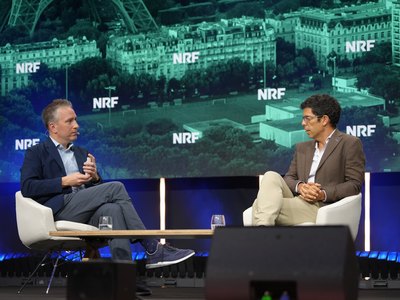
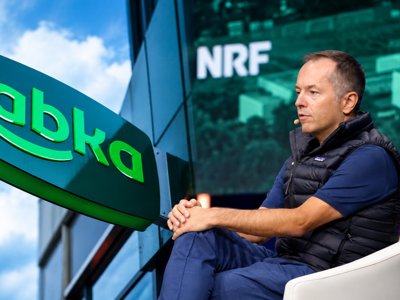
Alex Baldock on Currys, AI and Retail's Industrial Revolution
Alex Baldock, then Currys CEO and now incoming Boots CEO, frames AI as a steam-power-scale shift and explains how 'home of AI' shows up in colleague tools, SMB services and a 75% UK market share in AI laptops.
- 1Currys CEO Alex Baldock called AI the biggest general purpose technology innovation since steam power, comparing its impact to the Industrial Revolution.
- 2Currys holds 75% market share in AI laptops in the UK, backed by colleague training and partnerships with Google and Microsoft.
- 3The retailer's push into small and medium-sized business customers has expanded its total addressable market by 60%.
Editor's note: Alex Baldock was CEO of Currys at the time of this interview. He has since announced his departure from the role and been appointed CEO of Boots, joining the business in autumn 2026.
There is a version of the AI conversation in retail that is all hype and no substance. Alex Baldock, who led Currys through one of the most turbulent eight-year periods in British retail history, is not interested in that version.
"Our cool, dispassionate assessment of it," he told the interviewer, "is that it is the biggest general purpose technology innovation since steam power. That might have massively augmented human strength and enabled the Industrial Revolution. This gives super intelligence, pretty much unlimited, to every individual and every business on the planet. And we are day one of working out what to do with it."
That framing, serious, grounded, deliberately understated, set the tone for a wide-ranging conversation about what AI actually means for a business like Currys, and what it takes to lead through transformation when the ground keeps shifting beneath you.
What Home of AI Actually Means
Currys has positioned itself publicly as the "home of AI," a phrase that could easily become marketing noise. Baldock was clear about what it means in practice.
For Currys, AI is not a strategy in itself. It has to reinforce what the business is already about, which is helping customers demystify and democratise technology. If consumer tech is already confusing for many people, AI on top of it risks being, as Baldock put it, "downright scary." The job of Currys is to make it accessible.
He walked through what that looks like in conversation with a customer in store. A colleague trained to have the AI discussion might explain that even an average photographer can produce remarkable results with AI assistance, that real-time language translation is now available to any traveller, that a student writing a dissertation can effectively have a team of experts available around the clock, or that someone with a business idea but no coding skills can now build it regardless.
"Everyone should have a Tracy," Baldock said, referring to his own executive assistant of nearly twelve years. "Democratise the PA. Democratise the resources previously in reserve of large organisations. That is what home of AI means."
Small Businesses as a Growth Engine
One of the clearest expressions of that democratisation argument is Currys' push into small and medium-sized business customers, a segment that has grown the company's total addressable market by 60%.
The logic is straightforward. Large organisations like Currys have access to accounting, finance, legal, analytics, and operational support as a matter of course. A plumber running a three-person business has none of that. AI, delivered through the right products and services by a trusted omnichannel retailer, changes the equation entirely.
"A plumber with three employees can now access the kind of support that was previously in reserve of only large organisations," Baldock said.
He also made a point that cuts against the assumption that AI will advantage pure digital players. In a world increasingly mediated by AI agents and platforms like ChatGPT, the way a brand shows up in search is shaped not just by product catalogue breadth but by trust, customer advocacy, and reputation for reliable service. Currys, which has been trading since the nineteenth century, sees that as a structural advantage. "In many ways, AI plays to the strengths of large omnichannel incumbents," he said.
Five Things Friday
Five useful signals from the people shaping global retail. Every Friday.
75% Market Share in AI Laptops
The numbers back up the confidence. Currys now holds 75% market share in AI laptops in the UK, a figure Baldock attributed to sustained investment in colleague training, deep partnerships with Google and Microsoft, and the company's omnichannel model.
The business is now approximately 50/50 between online and physical retail, the result of a digital transformation that has reshaped the company over the past several years.
Baldock's view on what comes next for e-commerce is pointed. "The e-commerce customer experience has not moved on an enormous amount in 30 years," he said. "When you still fill in the form online, you get a catalogue of stuff back." Agentic AI, in his view, will end that model entirely, replacing it with a conversational experience where the customer articulates a need and the retailer provides the right solution, online or in store.
AI on the Shoulder of Every Colleague
In stores, the practical expression of AI is already taking shape. Every Currys colleague carries an iPad loaded with information on stock, pricing, promotions, and product availability. The next phase is making that assistance progressively more personalised and more sophisticated.
The goal, as Baldock described it, is to level up every colleague to the standard of the very best. A brand new member of staff on their first week should be able to help a customer as effectively as the most experienced colleague in the business. The AI assistant makes that possible by knowing every product, every solution, and learning about every customer, then helping the colleague put the right combination in front of the right person.
"Every colleague can have an AI assistant on their shoulder," he said. "Helping them help the customer."
The same principle applies to solution selling. Rather than selling a single laptop, a colleague equipped with AI assistance can confidently bundle the cable, mouse, monitor, bag, software, security, and support package that fits the customer's specific situation. That is better for the customer and considerably better for the business.
Inside the Operation: Nine Teams, Smarter Stores
Beyond the shop floor, Currys has reorganised internally around nine cross-functional product teams focused on improving the company's major operational processes, from supplier onboarding and product setup to range management.
In stores, Baldock described a tool called "action AI" that helps store managers identify patterns and trends in their sales compared with similar stores, spot where stock is not flowing effectively, and find opportunities to roster colleagues more efficiently. The rollout was not without friction. "I won't pretend that this was necessarily an easy sell initially," he said. But adoption followed the classic pattern: early adopters achieved visible results, and demand from the rest of the team followed.
The same approach is being applied across back-office functions. Baldock described asking teams across finance, HR, legal, and technology to identify the most repetitive, draining, and least valuable parts of their work, and then systematically removing that friction with AI tools.
On customer service and after-sales, he singled out repairs as a specific area being transformed by AI, with tools now matching the right technician to the right job with the right parts, improving first-time fix rates and reducing cost.
Honesty About Disruption
Baldock did not soften the harder edges of the AI conversation when it came to the workforce.
"It is going to change every job," he said. "And that is going to mean some jobs in their current form will not exist anymore. But it will also mean new jobs will be opened up."
His approach is to begin with honesty rather than reassurance. Currys is not telling colleagues that nothing will change. It is telling them that change is coming, that they have a responsibility to upskill, and that the company will provide the tools, training, and support to help them do it. The framing he offered employees is that AI will not take their job, but someone who knows how to use AI might.
Leading Through Volatility
Asked about the broader challenge of leading through sustained uncertainty, including multiple government changes, cost of living pressures, wars, shortages, and supply chain disruption, Baldock offered two principles.
The first is strategic consistency. People need to know where the business is going even when the path shifts. At Currys, that has meant a clear, widely understood strategy around the assisted sale, omnichannel solutions, and building customers for life. Everyone in the business can articulate it, and it flows into every set of objectives.
The second is cultural. A clear strategy is not enough if the organisation cannot sense when it needs to change course. That requires a culture where people actively want to speak up, challenge, and flag problems. "We're extremely argumentative," Baldock said, with evident satisfaction. "And people are really good at continually telling me what we need to do better. But that's great. That's the growth mindset."
The two things together, direction and adaptability, are what allow a business to hold its course through turbulence without becoming rigid.
After eight years at Currys, Baldock reflected briefly on what the tenure had meant. "We might as well do something that matters," he said. "We've built a stronger business for colleagues, customers, and shareholders. But we've built one, I think, with some lasting impact. We're helping millions of people stay connected, productive, healthy, fit, clean, entertained. That gets me out of bed in the morning."
It is a fitting summary for a leader who spent the interview making the case that technology, however powerful, is only as good as the human purpose behind it.
Frequently Asked Questions
What is the key point of "Alex Baldock on Currys, AI and Retail's Industrial..."?
- Alex Baldock, then Currys CEO and now incoming Boots CEO, frames AI as a steam-power-scale shift and explains how 'home of AI' shows up in colleague tools, SMB services and a 75% UK market share in AI laptops.
What Home of AI Actually Means?
- Currys has positioned itself publicly as the "home of AI," a phrase that could easily become marketing noise. Baldock was clear about what it means in practice. For Currys, AI is not a strategy in itself.
Small Businesses as a Growth Engine - what does it mean?
- One of the clearest expressions of that democratisation argument is Currys' push into small and medium-sized business customers, a segment that has grown the company's total addressable market by 60%. The logic is straightforward.
75% Market Share in AI Laptops - what does it mean?
- The numbers back up the confidence. Currys now holds 75% market share in AI laptops in the UK, a figure Baldock attributed to sustained investment in colleague training, deep partnerships with Google and Microsoft, and the company's omnichannel model.
AI on the Shoulder of Every Colleague - what does it mean?
- In stores, the practical expression of AI is already taking shape. Every Currys colleague carries an iPad loaded with information on stock, pricing, promotions, and product availability. The next phase is making that assistance progressively more personalised and more sophisticated.
Related coverage

Electronics
SharkNinja, Currys, and DoorDash Show How AI Is Becoming Retail's Operating System
Apr 16, 2026
Electronics
Best Buy's Supply Chain Transformation: Data, Culture and AI at Scale
Feb 21, 2026Electronics
How SharkNinja Is Winning the Small Appliance Market Through Relentless Innovation
Feb 12, 2026Electronics
How Amazon is Now in the Sustainable Retail Game
Nov 29, 2023Best Buy's Supply Chain Transformation: Data, Culture and AI at Scale
Best Buy's Chief Supply Chain Officer Mark Irvin explains how data, digital twins and partnerships are reshaping its North American logistics network. From AI driven sourcing to zero waste distribution centers, here is how the $42 billion retailer is building a smarter supply chain.
Continue readingMore in Electronics

🔍 Explore related coverage