VF Corp CEO Bracken Darrell on Transformation, AI, and Human-Centered Retail
VF Corp CEO Bracken Darrell is rebuilding Vans, The North Face, Timberland, and Supreme through long-term thinking, operational discipline, and a renewed focus on brand equity. He treats AI as transformative but disciplined - VF is testing it across 17 areas - while arguing that authentic human experiences will become more valuable, not less, as AI-generated content saturates daily life.
- 1Darrell treats turnarounds as long-term work, not short-term cost cycles, and places brand equity at the center of VF's strategy across Vans, The North Face, Timberland, and Supreme.
- 2VF is exploring AI across 17 different areas of the business, balancing near-term operational gains with longer-term strategic bets, while resisting the urge to bet the company on any single use case.
- 3Darrell argues that authentic human experiences - in-person communication, live events like Vans' Warped Tour revival, and immersive retail - will become more valuable as AI-generated content saturates everyday life.
At a moment when retail leaders are navigating economic uncertainty, operational reinvention, and the rapid rise of artificial intelligence, VF Corporation CEO Bracken Darrell offered a grounded perspective on what real transformation actually requires.
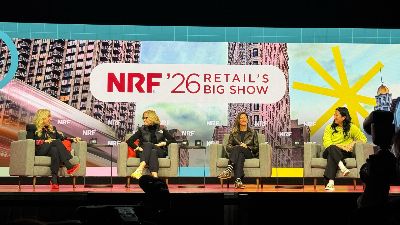
Speaking in conversation with Mindy Grossman - a partner at Conselho Group and former CEO of WW and HSN - Darrell outlined how he is reshaping VF Corp, the parent company of Vans, The North Face, Timberland, and Supreme, through a combination of long-term thinking, operational discipline, and a renewed focus on brand equity.
The conversation moved well beyond the mechanics of a turnaround. It became a broader discussion about leadership, organizational culture, and why authentic human experiences may become even more valuable in an AI-driven world.
Heritage Alone Is Not a Strategy
VF Corporation's portfolio of brands carries more than 125 years of cultural history. But as Grossman noted in framing the discussion, legacy is not a business plan - especially in an environment she described as more volatile, more complex, and more unforgiving than any point in recent history.
Darrell, who joined VF Corp during a period of mounting pressure on the business, challenged the conventional idea that turnarounds are fundamentally short-term exercises.
"I'm the longest-term person I know," he said. "You really have to take a very long-term view on turnaround."
That philosophy has shaped his approach at VF from the outset. Rather than treating the company's legacy as something to modernize away from, Darrell emphasized the importance of protecting and strengthening the equity embedded within VF's portfolio of brands.
"Brand equity is the most valuable thing in this company," he said. "Protecting that and respecting that and learning about it and really believing in it has to be where it starts."
For VF, whose brands occupy distinct cultural positions across outdoor, streetwear, and lifestyle categories, the challenge is not simply operational. Each brand carries a deeply rooted identity and community connection that cannot be separated from the business itself.
Building a Turnaround Around Discipline and Innovation
Darrell explained that many companies entering a turnaround phase share a common problem. After long periods of growth, organizations often continue expanding their overhead even after momentum slows.
"When growth stops, you're still very good at growing your overhead," he said.
One of VF's first priorities was therefore to reset costs and create greater operational discipline. At the same time, Darrell moved quickly to strengthen the company's innovation capabilities, particularly around product development and marketing execution.
Five Things Friday
Five useful signals from the people shaping global retail. Every Friday.
"This industry has very long cycle times for product development," he noted. "We had to start immediately saying, where are we going to change to make sure we have a great product pipeline coming out?"
Darrell also returned repeatedly to the importance of leadership and talent throughout the transformation process.
"It's all about people," he said, describing the need to place the right leaders into the right roles while also strengthening the board with directors who possess deep industry expertise - including Grossman herself, whom he cited as one of the first outside appointments he made.
Why VF Believes Multi-Brand Can Be a Competitive Advantage
A major focus of the discussion centered on VF's position as a multi-brand organization in an industry increasingly dominated by highly focused mono-brand companies such as Nike and Lululemon.
Darrell acknowledged the structural advantages that come with singular focus - every person at Nike wakes up thinking about Nike - but argued that VF's long-term opportunity lies in creating stronger shared capabilities across its portfolio.
"The only way that a multi-brand company can really have sustainable advantage is if you figure out how to leverage the fact that you've got multiple brands," he said.
He drew comparisons to companies such as Procter & Gamble, Unilever, and Diageo, where centralized systems and best practices support multiple category-leading brands simultaneously. Consumers never buy a product branded "P&G" or "Diageo" - but they consistently choose the individual brands those companies have built and sustained.
VF's goal, according to Darrell, is to create stronger organizational learning across the company - building best-in-class processes for product creation, marketing development, and talent building that benefit every brand without compromising their distinct identities.
Communication Remains the Most Important Leadership Tool
Despite the discussion around technology and AI, one of Darrell's strongest messages focused on communication and organizational alignment.
"The best form of communication is this," he said, referring to face-to-face interaction.
Darrell described a clear hierarchy of communication that he applies across VF's organization: in-person meetings first, followed by video calls, then phone calls, then text messages, with email as an absolute last resort.
"I hate email now," he admitted, arguing that written communication often creates misunderstanding and emotional distance inside organizations. He estimated that a significant share of HR issues within VF trace back to emails being misread or misinterpreted - friction that simply does not arise in direct conversation.
For Darrell, maintaining alignment during transformation depends heavily on direct and authentic interaction between leaders and their teams.
VF's Approach to AI: Practical Value Over Hype
Artificial intelligence inevitably became a central topic of the conversation, though Darrell approached the subject with a mix of optimism and measured caution.
He described AI as sitting at the peak of what is commonly called the Hype Cycle - a period where excitement and expectations consistently run ahead of reality. At this stage, he noted, the prevailing narrative tends toward extremes: AI will either eliminate most jobs within months or prove to be another overhyped technology trend that quietly fades.
Neither conclusion is accurate, in Darrell's view.
"I think AI is as transformative as most people are talking about," he said. "But the hype will come down a little - and then quietly, the line of reality keeps going up and up."
VF is currently exploring AI applications across 17 different areas of the business. Darrell declined to detail the specific initiatives for competitive reasons, but emphasized the importance of balancing near-term operational opportunities with longer-term strategic bets.
"I'm not betting the company on any of them," he said. "But I'm betting that some of those are going to be really significant."
Rather than viewing AI primarily as a cost-cutting mechanism, Darrell framed it as a tool that can reshape how companies operate, innovate, and connect with consumers over the coming decade.
Why Human Experiences Will Become More Valuable in the AI Era
One of the most compelling themes from the discussion was the idea that AI could ultimately increase consumer demand for real-world experiences and authentic community engagement - not diminish it.
"In a world where you don't really know what's real and what's not, people are going to value more and more these real things that happen," Darrell said.
That thinking is already influencing VF's broader brand strategy. He pointed to Vans' revival of the Warped Tour as a prime example of how brands can create meaningful cultural experiences that extend far beyond the products themselves - live celebrations of music, community, and shared identity that no algorithm can replicate.
Darrell argued that retail experiences will increasingly need to feel more human, more immersive, and more emotionally resonant as digital environments become more saturated with AI-generated content.
"We need to make our events actually more human, not less," he said.
For retailers, that shift could fundamentally reshape how stores, brand activations, and consumer communities are designed over the next decade. The brands that win will not be those that automate the most - they will be the ones that make people feel the most.
Leadership in a Time of Reinvention
Darrell closed the conversation with a personal reflection on resilience and reinvention, recounting a defining moment from his childhood when, at nine years old, he told his mother - who was struggling after his father left - to imagine dragging a stick behind her heels on a beach. Everything behind the line was only there to learn from. Everything ahead was still possible.
That image, he said, has stayed with him ever since - and grown richer in meaning as he has gotten older.
His advice to executives navigating transformation and technological disruption was ultimately centered on adaptability.
"Don't be stuck with what you were yesterday," he said. "You can redefine yourself every single day."
He encouraged leaders to remain flexible and open to redefining themselves as the demands of their roles continue to evolve - resisting the temptation to lean only on what has worked before.
"The demands of all of our jobs are absolutely going to change," he said. "You can be anything you want to be from that line forward."
For retail leaders facing an increasingly volatile landscape, Darrell's broader message was clear. Long-term success will not come from chasing every trend or reacting to every disruption. It will come from building organizations that can evolve while remaining deeply connected to their brands, their people, and their consumers - and from leaders willing to keep reinventing themselves along the way.
Frequently Asked Questions
What is the key point of "VF Corp CEO Bracken Darrell on Transformation, AI, and..."?
- VF Corp CEO Bracken Darrell is rebuilding Vans, The North Face, Timberland, and Supreme through long-term thinking, operational discipline, and a renewed focus on brand equity.
Heritage Alone Is Not a Strategy - what does it mean?
- VF Corporation's portfolio of brands carries more than 125 years of cultural history. But as Grossman noted in framing the discussion, legacy is not a business plan - especially in an environment she described as more volatile, more complex, and more unforgiving than any point in recent history.
Building a Turnaround Around Discipline and Innovation - what does it mean?
- Darrell explained that many companies entering a turnaround phase share a common problem. After long periods of growth, organizations often continue expanding their overhead even after momentum slows. "When growth stops, you're still very good at growing your overhead," he said.
Why VF Believes Multi-Brand Can Be a Competitive Advantage?
- A major focus of the discussion centered on VF's position as a multi-brand organization in an industry increasingly dominated by highly focused mono-brand companies such as Nike and Lululemon.
Communication Remains the Most Important Leadership Tool - what does it mean?
- Despite the discussion around technology and AI, one of Darrell's strongest messages focused on communication and organizational alignment. "The best form of communication is this," he said, referring to face-to-face interaction.
Related coverage

Leadership
Stanley 1913's Next Era: From Heritage Thermos to Global Hydration Powerhouse
Aug 20, 2026
Leadership
Arc'teryx CEO Stuart Haselden: How the Brand Grew 5x Without Betting on AI
Jun 18, 2026
Leadership
Zalando's Co-Founder Says Retail Is at an Inflection Point. Here Is What Comes Next.
Jun 1, 2026
Leadership