Groceryshop 2026: AI Agents Are Now Building the Grocery Basket
At Groceryshop 2026 in Las Vegas, Instacart, DoorDash and Kroger showed AI agents that assemble entire grocery baskets, while value-seeking shoppers, GLP-1 medications and in-store retail media are reshaping what goes into the basket and who influences it.
- 1Instacart, DoorDash and Kroger presented AI agents that build a full grocery basket from a shopper's stated goal, budget and preferences.
- 2DoorDash reported that Ask DoorDash users build baskets 50% larger and check out five times faster, a company-reported figure.
- 3Only 31% of retail media leaders are confident their revenue is truly incremental, according to EMARKETER and Bain research previewed at the event.
From AI agents that can plan an entire shop to GLP-1 medications reshaping food choices and retailers turning stores into media networks, Groceryshop 2026 revealed an industry being transformed from several directions at once. The common thread is clear: the grocery basket is no longer being built the way it used to be.
The grocery shop has always been full of decisions: what to cook, which brand to choose, whether to trade down, what is healthy enough and what is worth paying more for.
Artificial intelligence is beginning to make some of those decisions easier, and potentially to make some of them on the shopper's behalf.
That shift was one of the clearest themes to emerge from Groceryshop 2026 in Las Vegas. More than 4,000 retail leaders gathered there from grocery, convenience, pharmacy, dollar and club retail, alongside brands, technology providers and startups. The programme featured more than 150 speakers, with AI-powered shopping given a dedicated place on the agenda.
But AI was only one force changing the basket.
Consumers remain intensely focused on value. GLP-1 medications are influencing food choices. Retailers are building new advertising businesses around their stores and customer data. And brands face a growing challenge: making sure their products remain visible when an algorithm, rather than a shopper scrolling through a digital shelf, helps decide what gets bought.
Taken together, Groceryshop pointed towards an industry where winning the customer may mean influencing the systems that help build the basket.
From Search Bar to Shopping Agent
The most consequential change is the movement from AI as an assistant to AI as an agent.
Instacart CEO Chris Rogers opened Groceryshop with a striking prediction about the technology's impact on the sector:
"I believe that AI is going to transform grocery more than any other technology shift to date."
His example illustrates why.
Instead of searching for ingredients and adding products one by one, a shopper could ask for a healthy meal their children will eat for under $40. They would receive a full cart in seconds, based on their budget, their usual store and what is actually on the shelf.
Five Things Friday
Five useful signals from the people shaping global retail. Every Friday.
That changes the role of e-commerce.
The conventional digital grocery experience asks the customer to navigate categories, search for products, compare options and construct the basket themselves. Agentic shopping potentially reverses that relationship. The shopper describes an outcome; the system constructs the basket.
For a platform such as Instacart, the data behind that process is substantial. According to the Groceryshop release, Instacart has processed 1.6 billion orders, carries two billion items in its catalogue and handles 10 million signals a day.
The competitive question is therefore shifting from who has the best search bar to who can build the most useful basket.
Bigger Baskets, Faster Checkouts
DoorDash is also pushing conversational AI deeper into shopping.
Its Ask DoorDash service allows customers to describe what they need rather than navigate the app item by item. DoorDash launched the feature in June as a conversational way to search across restaurants and grocery.
At Groceryshop, co-founder Andy Fang said shoppers using the tool are displaying materially different purchasing behaviour.
According to figures presented by DoorDash at the event, Ask DoorDash users now have baskets 50% larger than those built without the tool. They also check out five times faster and buy 60% more unique items. At launch in June, the equivalent figures were 35% larger baskets and three times faster checkout.
Those are company-reported figures rather than independent measurements, but the direction is commercially significant.
If AI reduces the effort required to build a grocery order, it may do more than make e-commerce easier. It could change basket economics, and that is a much bigger proposition.
Solving for Dinner
Kroger is taking a similar approach.
Its AI Shopping Assistant can help customers plan meals, discover recipes and construct a basket around budget, dietary requirements and preferences. The retailer launched the assistant in July across the websites and apps of the Kroger Family of Companies.
At Groceryshop, Kroger EVP and Chief Digital Officer Yael Cosset outlined a wider AI strategy spanning customers, store operations and employees.
The company is making AI literacy training and tools available to more than 400,000 associates. It is also exploring a future in which grocery becomes what Cosset described as a "managed service". Rather than creating a weekly shopping list themselves, customers could share goals and preferences and allow AI agents to plan and complete the shop.
That distinction matters.
Traditional personalisation asks which product a customer is most likely to buy. Agentic grocery asks what the customer is actually trying to achieve, whether that is dinner for four, a high-protein week, a cheaper basket, meals that fit a dietary restriction or a children's lunchbox.
Once the objective becomes the starting point, individual products risk becoming components of an answer rather than destinations in themselves.
For brands, that could be one of the most important consequences of AI-powered shopping.
The Machine-Readable Shelf
If AI is going to construct baskets, it needs to understand the products inside them.
That makes product data strategically important, and shoppers appear ready to trust the results. Accenture research cited in the Groceryshop release found that 75% of global consumers would trust an AI agent more than their best friend. It also found that 56% of loyal shoppers would switch brands if their agent recommended a better option.
The foundations are less advanced. Incisiv research shared at the event found only 7% of enterprises have scaled AI across their businesses. DoorDash's Fang called clean product data a "no regrets move" for retailers. He noted that almost 95% of DoorDash customers choose an item with a good product description over one without.
The implication extends well beyond DoorDash.
For decades, grocery brands have competed for physical shelf position. E-commerce added competition for digital search rankings. Agentic commerce introduces another layer: machine readability.
Consider an AI agent deciding which yoghurt, cereal or ready meal best matches a customer's request. It needs structured information about price, ingredients, nutrition, dietary characteristics, availability and other product attributes. A product the machine cannot understand may become harder to recommend.
The digital shelf is beginning to acquire a new gatekeeper.
The End of the Average Shopper
Technology is changing how the basket is assembled just as economic pressure is changing what shoppers are willing to put into it.
At Groceryshop, Nicole Kalita, SVP and Managing Director of US Retail at NielsenIQ, argued that the "average shopper" no longer exists.
According to NielsenIQ figures in the release, financially stretched households now make up 33% of the US population, up 17% since 2022. Grocery, meanwhile, has lost $5 billion in trips over three years as shoppers move to club and mass formats.
"Consumers are no longer hunting for a deal, they're assembling one," Kalita said.
The significance is not simply that consumers want lower prices. They are becoming more deliberate about where each trip happens. A warehouse club may win one mission, a supermarket another, and mass or convenience formats others still.
That fragmentation makes value more complicated than simply being cheapest. For retailers, value now needs to include price, assortment, convenience, delivery, membership benefits and the relevance of the overall proposition.
Sam's Club provided one example. EVP and Chief Merchant Myron Frazier said the retailer charges the same price online as in its clubs, with no upcharge for delivery. He said it applies the same thinking to checkout, delivery and meal solutions as it does to merchandise, treating each as another opportunity to create member value.
The basket is being competed for one trip at a time.
Less Volume, More Value
Another shift is happening inside the basket itself.
GLP-1 medications have become part of the grocery conversation because they can influence appetite, portion size and the types of foods consumers prioritise. The Groceryshop release describes them as speeding up the shift towards protein, nutrition and cleaner labels.
Chobani SVP of Commercial Growth Talia Monroe said consumers are spending more money on food than ever, while choosing fewer calories and less ultra-processed food.
That creates a different kind of value equation. A smaller basket does not necessarily mean a lower-value basket. Consumers may buy less volume while becoming more selective about nutritional density, ingredients and product quality.
For food manufacturers and retailers, the opportunity is not simply to sell "GLP-1 products". It is to understand how changing health priorities affect category demand, pack sizes, innovation, merchandising and assortment.
Groceryshop VP of Content Rocquan Lucas said the average grocery cart is set to change more in the next few years than it has in decades. He said shoppers are leaning on AI assistants, becoming more selective with their purchases and adjusting what and how much they consume in response to GLP-1 adoption.
The Aisle as Ad Space
The third major shift at Groceryshop happened not inside the basket but around it.
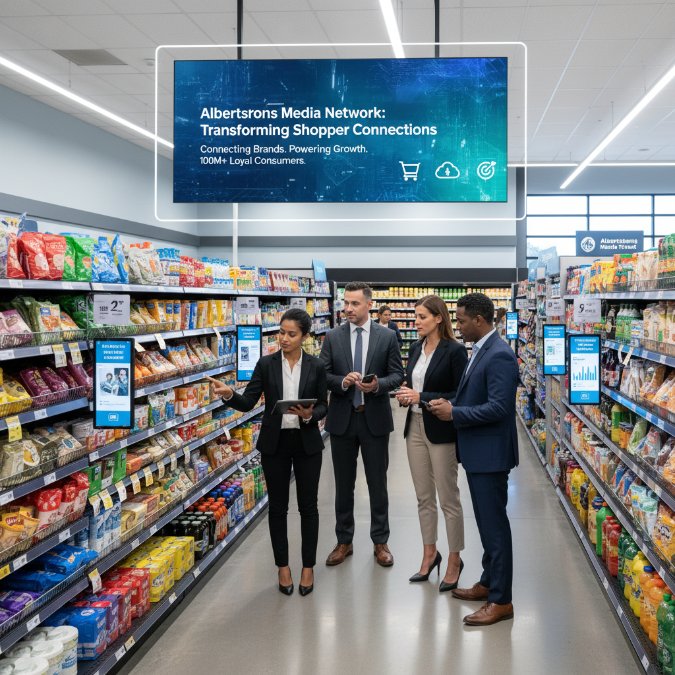
Retail media is moving further into physical stores.
Independent analyst Andrew Lipsman described in-store retail media as a $20 billion opportunity. He noted that stores capture 5% of consumer time but only 0.1% of advertising spend.
CVS Media Exchange is already building towards that opportunity. According to the release, its network now includes 26,000 new point-of-sale devices and 2,500 waiting-area screens, and a Dove campaign generated a 51% new-to-brand lift. Those performance figures should be treated as company-reported results.
But the strategic direction is clear. Retailers no longer see stores solely as places where media converts into a transaction. The store itself is becoming media inventory.
Screens, apps, loyalty programmes, checkout technology and first-party customer data can all become part of an advertising proposition. That gives retailers something traditional media owners cannot easily replicate: the ability to connect exposure much more closely with purchase behaviour.
Proving It Works
The opportunity is large. Confidence in measurement is not.
Research from EMARKETER and Bain, previewed at Groceryshop ahead of its October publication, found that only 31% of retail media leaders are confident their revenue is truly incremental. On the brand side, Kantar data cited in the release found only 22% are confident they can measure return on investment.
That is a problem for an industry attracting ever-larger budgets. A retailer may not be able to establish whether advertising generated incremental demand or merely captured a purchase that would have happened anyway. If so, the value of the media network becomes harder to prove.
AI could complicate that tension further. The same research found that three of the five biggest forces retail media networks expect to disrupt their revenue are AI-related. Retailers' own AI advertising products were also ranked as the second-largest expected revenue driver, and 77% of networks are testing or investing in new AI ad formats.
EMARKETER Principal Analyst Sarah Marzano described AI as both a threat to today's economics and an opportunity to build the next generation of monetisation capabilities.
So AI is not only changing how consumers shop. It is beginning to change how retailers monetise the shopping journey.
Beyond the Media Buy
For brands, Groceryshop's retail media discussion also pointed towards a shift away from isolated campaigns.
P&G SVP of Brand Operations Jacques Hagopian called for 12- to 18-month joint plans that line up supply, in-store display and media. "The best marketing in the world cannot sell a product that's not there," he said.
Danone offered an example of that joint planning in practice. A New Year campaign with Target's Roundel delivered 131 million impressions and reached around 233,000 new Target shoppers, according to figures presented at Groceryshop.
The more important idea is not the impression count but the integration. As Erin Anderson, VP of Customer Commerce at Danone North America, put it: "Retail media is really more than just a media buy."
Media is now connected to assortment, merchandising, availability and physical stores. That means brands cannot treat retail media as simply another advertising line item. The strongest programmes may be those that connect the commercial plan and the media plan.
A strong product launch cannot reach its potential if shoppers cannot discover it. And in an AI-mediated shopping environment, neither availability nor discoverability may matter if the product data is not good enough for the agent to recommend it.
Winning the Algorithmic Basket
Groceryshop 2026 produced plenty of technology announcements. Instacart and Gopuff are expanding their relationship, with Gopuff joining the Instacart Marketplace and using Instacart Carrot Ads on its own storefront. Kroger set out its AI strategy and its vision for grocery as a managed service. DoorDash introduced Brand Center, designed to give marketing, supply chain, category, e-commerce and national account teams a clearer view of what is driving growth across the digital and physical shelf. Away from the technology, California Pizza Kitchen announced a frozen appetiser range with Golden West Food Group, due in stores next year.
Viewed as a whole, the announcements reveal something larger: the battle for the grocery basket is changing.
For decades, retailers competed primarily through stores, price, range and location. E-commerce added convenience and digital discovery. Retail media turned customer attention and transaction data into advertising inventory. AI could now introduce another competitive layer by helping decide what the basket contains before the customer ever reaches a shelf.
That raises a new set of questions. Which retailer owns the shopping agent, and which products does it recommend? What data informs those recommendations, how does a brand remain discoverable, and who controls the customer relationship?
And what happens when a consumer stops searching for individual products and simply asks an AI system to solve dinner?
The grocery basket is unlikely to disappear. But the person building it may increasingly have help.
And in the next phase of grocery, winning the basket could depend as much on being understood by the algorithm as on being noticed by the shopper.
Sources
This article draws on Groceryshop's media release of 24 September 2026, covering Groceryshop 2026 at Mandalay Bay, Las Vegas, alongside announcements from Kroger (28 July and 22 September 2026) and DoorDash (June 2026). Statistics are attributed to the companies and research firms that produced them, and performance figures are company-reported unless otherwise stated.
Frequently Asked Questions
What is the key point of "Groceryshop 2026: AI Agents Are Now Building the Grocery..."?
- At Groceryshop 2026 in Las Vegas, Instacart, DoorDash and Kroger showed AI agents that assemble entire grocery baskets, while value-seeking shoppers, GLP-1 medications and in-store retail media are reshaping what goes into the basket and who influences it.
From Search Bar to Shopping Agent - what does it mean?
- The most consequential change is the movement from AI as an assistant to AI as an agent. Instacart CEO Chris Rogers opened Groceryshop with a striking prediction about the technology's impact on the sector: "I believe that AI is going to transform grocery more than any other technology shift to date." His example...
Bigger Baskets, Faster Checkouts - what does it mean?
- DoorDash is also pushing conversational AI deeper into shopping. Its Ask DoorDash service allows customers to describe what they need rather than navigate the app item by item. DoorDash launched the feature in June as a conversational way to search across restaurants and grocery.
Solving for Dinner - what does it mean?
- Kroger is taking a similar approach. Its AI Shopping Assistant can help customers plan meals, discover recipes and construct a basket around budget, dietary requirements and preferences. The retailer launched the assistant in July across the websites and apps of the Kroger Family of Companies.
The Machine-Readable Shelf - what does it mean?
- If AI is going to construct baskets, it needs to understand the products inside them. That makes product data strategically important, and shoppers appear ready to trust the results.
Related coverage

Grocery
M&S Food Put Its Entire Range on Machine Learning
Sep 24, 2026Grocery
BM Is Rebuilding the Spanish Supermarket Shoppers Thought Lost
Jul 28, 2026
Grocery
Target and OpenAI Reveal How Retail Will Shift From "Using AI" to "Running on AI" in 2026
Feb 4, 2026
Grocery