World's Coolest Retailers 2026: Louis Vuitton Shanghai Tops List
The World's Coolest Retail Report 2026 ranks Louis Vuitton Shanghai, Haus Nowhere and Printemps New York at the top, with Pop Mart, Casetify, Anta, Mecca, Nothing, Vans and Olive Young filling out the global top 10.
- 1Louis Vuitton Shanghai took the No. 1 spot for turning maritime heritage into an immersive 1,600 square meter, 200-staff experience with Michelin-starred dining.
- 2Haus Nowhere by IICOMBINED, parent of Gentle Monster, ranked No. 2 as a 13-floor brand world in Seoul backed by Google and LVMH.
- 3Printemps placed third for a 6,000 square meter, 14-room department store at One Wall Street that reads more like a club than a shop.
Reported by Retailnews.ai
In a year shaped by uncertainty across geopolitics, culture, society and technology, retail has delivered something unexpected. Creativity is not slowing down. It is accelerating.
The World's Coolest Retail Report 2026, created by The General Store in partnership with the World Retail Congress, is now in its third year. The presenters made a clear case. Despite a difficult year on almost every front, the levels of innovation in retail have been phenomenal, and the creative side of the industry accounts for roughly half of what wins.
This year's report assessed retailers against three criteria. First, genuine creativity, with an eye for the X-factor moments where the strategy gets a brand only so far before a much bigger leap takes over. Second, commitment, because none of the top 10 value-engineered their way out of a bold idea. Third, commercial results, because this is not a celebration of art projects. As the presenters put it, in retail there are only two viable strategies. You are either the cheapest in your category or you are the coolest.
Here are the ten coolest retailers in the world for 2026.
No. 10: Olive Young
Olive Young is the heartbeat of K-beauty. The largest beauty retailer in South Korea operates around 1,200 stores and generates between $3.4 billion and $3.5 billion in annual revenue. The brand retails a level above its price tag, delivering a premium experience around entry to mid-market product and effectively democratizing premium beauty at scale. The wider context matters: K-beauty is now the fastest-growing beauty market in the world, recently outpacing the United States with 22% year-on-year growth, and disrupting a power structure historically led by France and the US.
Last year, Olive Young opened a new concept aimed squarely at the luxury end of the market: Olive Young N, in Seoul's Seongsu district. The N stands for four things: new, next, nest and network. The store spans 4,500 square meters across five levels of retail, presenting onto a town square that the brand activates with installations.
The format feels closer to a department store than a pure beauty execution. The ground floor, called Trend Fountain, is a 500 square meter space dedicated to product innovation and newness, with a cafe woven through it. Higher levels carry a wellness edit, a luxury perfume library and a substantial men's section. A food market sits on an upper floor with an outdoor terrace where shoppers can enjoy nutrition supplements in the sun. A VIP lounge, the Beauty Picnic, sits at the very top of the building.
The brand is not just selling products. It is building a platform for discovery and storytelling, and reshaping the global beauty landscape from Seoul outward.
No. 9: Vans
Vans, the founding father of global skate culture, celebrated its 60th anniversary this year.
The brand started as a rubber shoe company pitching to tennis culture, before skaters at Venice Beach in Los Angeles fell in love with the stickiness of its rubber soles and turned it into the global skate brand it is today. It is now a $2.4 billion business retailing through around 2,000 stores in approximately 50 markets. In recent years, Vans has expanded its world into art, music, fashion collaborations and large cultural events, including a culture-clashing collaboration with Valentino this year that drew significant attention.
What placed Vans firmly in the top 10 was its new flagship store on Regent Street in London. From the outside, it looks like a strong but relatively standard Vans environment. Inside, a large turret structure runs through the middle of the space, creating movement throughout the store and rising sharply at one end. At first it appears to reference a skate ramp. Then you realize the fixtures are on wheels, the units slide and slot into place, and the structure is not a reference to anything. It is an actual skate ramp running through the center of a retail store on one of the busiest shopping streets in the world. In the evenings, skaters take over the space and tear it up. The events have built an enormous social following. At a moment when Vans needed a big statement, it delivered one no competitor has matched.
Five Things Friday
Five useful signals from the people shaping global retail. Every Friday.
No. 8: Nothing
Nothing exists to make technology exciting again.
The smartphone industry has spent years delivering increasingly incremental innovation hidden inside near-identical devices, with most of the change happening in the back end. Nothing was built to bring personalization, creativity and romance back into the design of the product itself. The brand calls this disruption through design, leans into an analog aesthetic and positions itself as an antidote to the addictiveness of conventional tech. It is only four or five years old, has recently exceeded $1 billion in lifetime sales and is backed by Google Ventures.
Its product range has expanded into clear adjacencies, namely audio and a watch, each carrying the same edgy, fashion-leaning design language. Roughly two months before the World Retail Congress, Nothing announced an exclusive partnership with Harrods, a strong signal of how the luxury and design world is reading the brand.
In February, Nothing opened its first flagship store in the fastest-growing tech market in the world, in Bengaluru, India. The 2,000 square meter space sits in a beautiful neighborhood in the city. The interior is mechanical and maker-inspired, drawing on the industrial assembly lines of the 1970s. Everything is on caster wheels and flexible. The brand also throws large events from the space. A San Francisco flagship has been announced for later this year.
No. 7: Mecca
Mecca is the largest standalone beauty store in the world, and on the assessment of The General Store, the best beauty retailer in the world. The presenters at the World Retail Congress stood by the claim without qualification, even acknowledging Sephora is well-loved in the same category.
The Australian brand operates around 110 stores across Australia and New Zealand and generates approximately $1.4 billion in annual revenue. This year it opened its Melbourne flagship, a 4,000 square meter, three-story store housed in a heritage building in the center of Melbourne. Founder Jo Horgan described the concept as experiential retail on steroids.
What distinguishes Mecca is execution. It carries many of the largest names in beauty, but the Mecca world rises above all of them, giving the brands it stocks a hug while amplifying the broader sense of beauty and wellness. The detail is extraordinary, from individually tessellated tiles on the pylons that draw the eye up through the space, to artwork curated specifically for the store, to real plants throughout. At the back of level one, the Apothecary concept extends into customized gut-health tonics, capturing the beauty-from-the-inside-out idea.
Mecca now delivers around 1,300 beauty services every week from this single location. Its newly launched Meccaversity concept invites trainee beauticians to come in and immerse themselves in Mecca's philosophy, building the next generation of brand advocates from the inside.
No. 6: Anta
Anta is China's answer to Nike and global sneaker culture, and the most important brand most Western consumers have never heard of.
The third largest sportswear brand in the world behind only Nike and Adidas, Anta operates 12,000 stores, generates $13 billion in annual revenue and grew 25% year on year in its most recent results. Its store hierarchy is built around flagship executions, executed beautifully, and is now stepping up another level. Two new large-format Arena stores exist in the world: one in Shenzhen and one in Chengdu, the latter opened roughly two weeks before the World Retail Congress. Each is around 3,000 square meters and is built as a basketball lover's destination.
The cultural turning point came when Anta brought on NBA player Kyrie Irving, currently of the Dallas Mavericks. Rather than appointing him as a traditional ambassador, the brand made him Chief Creative Officer of Basketball and worked with him to bring his artistic vision for sneaker culture to life. Irving described the partnership as redefining the relationship between sport and creativity, and inspiring athletes and artists to embrace their individuality.
That positioning then became the strategic vehicle for Anta's entry into the United States. Its first US store opened in Beverly Hills in March 2026. The brand has also developed a smaller-format concept called Sneaker Verse, an expertly curated sneaker proposition currently operating in Beijing, Shanghai and Shenzhen, explicitly going after the Kith market. Anta is the biggest sleeping giant in global street and sportswear culture.
No. 5: Casetify
Casetify has flipped utility into creative expression. What used to be the plastic and rubber wrapping around a phone is now a canvas for self-expression. The 12-year-old brand turns over around $300 million in annual revenue from products that sell for around $90 each, with extraordinary margins.
The reason Casetify made this list is its flagship in Dosan, Seoul. The four-story building is a knock-down rebuild, an absolute commitment of capital and vision and a temple to the brand. The exterior carries the brand language directly: the curves, the window shapes and the color palette of a phone case. The ground floor extends those cues, with a sculpture of one of the brand's expressive luggage locks pushing up from the floor into the level above.
The first floor houses the customizable luggage range, complete with deliberately rough surfaces to practice rolling over. The third floor includes a cafe and bakery clad entirely in recycled Casetify cases, with the running joke that it is dangerous to put your phone down because it could disappear. The customization workshop is also on the third floor, where the small machinery is wrapped in a theatrical, vault-like casing that turns a small process into a dramatic retail moment. A rooftop event space sits at the top.
No. 4: Pop Mart
Pop Mart sits at the intersection of retail, art and entertainment, and is one of the most prolific art companies in the world.
At its core, the business operates more like a record label than a retailer, working directly with artists across distribution, IP and licensing. It sees itself as an art company first. The collaborations are increasingly prevalent and culture-clashing. Its blind box model, where customers buy a box without knowing the character or colorway inside, has built a global collector community on scarcity, exclusivity and the thrill of the unknown.
The $5 billion business grew 204% in 2025. Its Monsters family alone, which includes Labubu, accounts for $2 billion of that revenue. The store network is extraordinary in both ambition and scale: 635 flagship stores worldwide and around 2,500 Robo Shops, automated vending machines that bring the product closer to customers in locations where a full store would not be viable.
The most recent major flagship opened in Bangkok on the rooftop of Icon Siam, one of the most prolific shopping centers in Asia, with a purpose-built installation overlooking the city. A pop-up at the Louvre in Paris brought the brand into one of the world's most significant cultural institutions, a strong signal of how seriously the art world is engaging with what Pop Mart has built. Roughly two weeks before the World Retail Congress, Pop Mart announced a partnership with Sony Pictures to move into the entertainment space. The trajectory suggests this could ultimately become as much an entertainment company as a retailer.
No. 3: Printemps
The arrival of Printemps in New York is a cultural clash of the titans. This is what happens when the French take on the Americans at their own game, planting their flag at One Wall Street, the home of the American department store.
The 6,000 square meter space spans 14 individually designed rooms, each with its own identity, atmosphere and scale, with four or five hospitality offerings woven through the building. The Red Room, formerly the reception area for high-net-worth individuals when One Wall Street was a bank, has been turned into a stunning women's shoe room, designed collaboratively with artists.
The overall experience has been described as closer to a Soho House club that you can also shop than a conventional department store. What pushed Printemps into the top three was the commitment to the execution. This is not a department store playing it safe. This is full send.
No. 2: Haus Nowhere
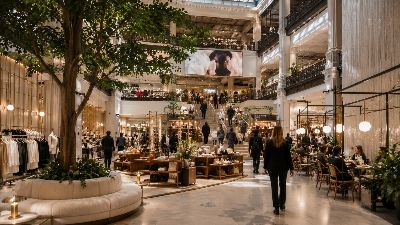
Haus Nowhere is the place that exists nowhere. The venture is created by IICOMBINED, the parent company behind Gentle Monster and Tamburins, one of the most iconic hardware groups in the world, backed by Google and LVMH since 2018. IICOMBINED also owns Nudake, a patisserie cafe, Atiissu, a headwear brand, and Nuflaat, a homewares brand. Haus Nowhere is the first time the company has brought all of its brands together under one stable.
The building opened in Seoul roughly two months before the World Retail Congress. Five floors are open to the public, eight floors house IICOMBINED's offices and the rooftop is an event space. The company also acquired and demolished an adjacent site to create an activation space beyond the four walls of the building itself, underscoring the scale of the commitment.
There is no shop front and no expression to the street. The building is deliberately introverted. Step inside and you are greeted by Sunshine, a 13 meter long animatronic dachshund installed as a temporary activation tied to a Tamburins perfume launch, occupying the center of the ground floor with a presence that goes to the nth degree of storytelling.
Each floor delivers a completely different spatial identity. The Gentle Monster level surrounds eyewear with monumental, slightly distorted sculptures that loom over shoppers. Higher up, Atiissu and Nuflaat share the more recently launched physical expressions of those brands. At the top, the Nudake tea house is reached by a small lift in the corner of the building, accompanied by ominous, end-of-the-world music, opening into a serene and tranquil space entirely at odds with everything below.
When the presenters visited the week before the World Retail Congress, a partnership activation with Disney and Formula 1 was running inside the building. There is no one in the world doing what IICOMBINED is doing in retail experience and creative ambition.
No. 1: Louis Vuitton Shanghai
At the top of the list is Louis Vuitton's flagship in Shanghai, a case study in redefining heritage as a brand anchor and using it to move forward.
The 1,600 square meter store is staffed by 200 people. Customers are escorted through the experience and the stories are unfolded as they walk. The brand's heritage as a maritime travel brand is everywhere, including the trunks that once traveled on ships like the Titanic, which serve both as anchor and as a tribute to Shanghai's identity as the most important maritime port in East Asia. The entrance turns product into art. Each room beyond it tells a different story, with no signage, the narrative carried entirely by the people in the store.
Michelin-starred dining is part of the experience and is reportedly phenomenal. The brand's iconography is even topiaried into the bushes outside the building. Nothing is left to chance. This is luxury retail when every detail is executed at the absolute highest level.
Why Creativity Is Becoming Retail's Greatest Advantage
The most important takeaway from this year's report is not which brands made the list. It is why they made it.
Each of these retailers made a deliberate choice. They committed to creativity, invested without compromise and built things that resonated with customers while driving real commercial results. None of them value-engineered their way out of a bold vision. All of them went full send.
Retail is no longer just about distribution or price. It is about relevance, and relevance is increasingly built through creativity, experience and the willingness to do things that do not quite make sense until they obviously do.
In a rapidly changing world, that may be the most powerful competitive advantage of all.
Frequently Asked Questions
What is the key point of "World's Coolest Retailers 2026: Louis Vuitton Shanghai Tops..."?
- The World's Coolest Retail Report 2026 ranks Louis Vuitton Shanghai, Haus Nowhere and Printemps New York at the top, with Pop Mart, Casetify, Anta, Mecca, Nothing, Vans and Olive Young filling out the global top 10.
No. 10: Olive Young - what does it mean?
- Olive Young is the heartbeat of K-beauty. The largest beauty retailer in South Korea operates around 1,200 stores and generates between $3.4 billion and $3.5 billion in annual revenue.
No. 9: Vans - what does it mean?
- Vans, the founding father of global skate culture, celebrated its 60th anniversary this year. The brand started as a rubber shoe company pitching to tennis culture, before skaters at Venice Beach in Los Angeles fell in love with the stickiness of its rubber soles and turned it into the global skate brand it is today.
No. 8: Nothing - what does it mean?
- Nothing exists to make technology exciting again. The smartphone industry has spent years delivering increasingly incremental innovation hidden inside near-identical devices, with most of the change happening in the back end.
No. 7: Mecca - what does it mean?
- Mecca is the largest standalone beauty store in the world, and on the assessment of The General Store, the best beauty retailer in the world. The presenters at the World Retail Congress stood by the claim without qualification, even acknowledging Sephora is well-loved in the same category.