Zalando Co-CEO David Schröder: AI Is Rewriting Fashion Retail
Zalando co-CEO David Schröder says AI is already transforming fashion retail at scale, with 90% AI-generated Concept Store content, a 10% drop in returns from AI size recommendations, and 10 million users on its AI shopping assistant. He warns Europe risks ceding commerce infrastructure unless it fixes scaling, growth capital, and single-market conditions for technology companies.
- 1Around 90% of Zalando's Concept Store content is now AI-generated, cutting campaign cycles from eight weeks to days.
- 2AI size recommendations reduced returns by 10% in the past year, while the AI shopping assistant drew about 10 million users in its first quarter.
- 3Schröder warns Europe must fix scaling, growth capital, and single-market gaps or cede commerce infrastructure to US and Chinese platforms.
Zalando has spent 17 years building the infrastructure to become Europe's dominant fashion and lifestyle platform. According to co-CEO David Schröder, artificial intelligence is now the layer that makes everything that infrastructure can do dramatically more powerful, and the companies moving fastest to apply it are pulling away from those that are not.
Speaking at a retail industry event, Schröder outlined how AI is already delivering measurable results across Zalando's business, from marketing and customer experience to returns reduction and cross-border logistics, while issuing a pointed warning that Europe must do more to support the technology companies capable of competing globally. His message was not theoretical. He came with numbers, and the numbers are striking.
The Results Are Already In
The shift Schröder described at Zalando is not a roadmap. It is a live transformation with figures to match.
Approximately 90% of the content within Zalando's Concept Store is now generated or supported by AI, compared with virtually none just a year earlier. That shift has transformed the economics of content production entirely, moving the business from an eight-week campaign cycle to creating and launching marketing in a matter of days. In a market where trend cycles are compressing and consumer attention moves faster than any traditional schedule can follow, that speed is not a nice-to-have. It is a competitive necessity.
AI is also tackling one of fashion e-commerce's most persistent and expensive problems: returns. AI-based size recommendations have already reduced returns by 10% over the past year. At Zalando's scale, even a modest improvement in that metric translates into billions fewer returns, significant cost savings, lower emissions, and meaningfully better customer satisfaction.
Then there is the AI shopping assistant, and this is where Schröder's numbers become particularly telling. The tool, which allows shoppers to engage in richer, conversational interactions rather than typing keywords into a search bar, attracted approximately 10 million users in its first quarter after launch. But what those users are doing with it is just as significant as how many of them exist. Where a traditional search query meant typing a keyword once and scanning the results, customers using the AI assistant are now asking an average of three to five questions per session, sometimes more, in a genuine back-and-forth dialogue.
"It becomes much more of a conversation," Schröder said. "And that's where the magic happens, because we get to understand what they're really looking for."
The assistant learns what customers are shopping for, why they are shopping, what occasions or events are coming up, where they are going on holiday. That context makes the recommendations qualitatively different from anything a keyword search can produce. Schröder sees the shift from search to conversation as one of the defining changes in how consumers will interact with retail over the next several years, not as a feature but as the new default.
From Retailer to Platform: The Transformation Most Consumers Have Not Noticed
While many consumers still associate Zalando primarily with buying fashion online, Schröder was clear that the company has undergone a more fundamental change beneath the surface.
Zalando now operates three distinct consumer-facing apps. The main Zalando app is built around bringing the best of brands and products to life across Europe. About You, acquired in 2025, is more trend-focused and social in its orientation. And Zalando Lounge is the off-price, daily-deals destination, the app customers open first thing in the morning for the thrill of the hunt and the excitement of limited-time offers. Each has a distinct proposition and serves a distinct community. Together they give the group reach across very different types of fashion and lifestyle consumer.
But the deeper transformation is on the B2B side. Zalando is increasingly operating as a technology and infrastructure provider for brands and retailers across Europe, opening up its logistics network, software capabilities, and operational systems to partners who want to expand their reach without having to build that infrastructure themselves. In 2025, B2B revenues surpassed 1 billion euros for the first time, growing 14.6% year-over-year, with adjusted EBIT more than doubling.
The partnership with British retailer Next illustrates the model in its most concrete form. Through Zalando's ZEOS logistics infrastructure, Next gained access to cross-border fulfilment across most of continental Europe. According to Zalando's 2025 annual results, Next achieved a 33% increase in international online sales while reducing fulfilment costs by 6.5%. The partnership has since become a reference case for what happens when shared infrastructure removes the friction of operating across Europe's fragmented market.
Five Things Friday
Five useful signals from the people shaping global retail. Every Friday.
"Within one single year, sales are up and costs are down," Schröder said of the collaboration. "It really shows how this unlocks tremendous value, because there is so much inefficiency still in the system because of different borders and the intricacies of how local delivery works."
Zalando's modular B2B operating system, which spans logistics through ZEOS, shop and marketplace software through SCAYLE, and marketplace integration through Tradebyte, now serves over 1,200 merchants and enables around 11 billion euros in gross merchandise value.
Europe Has a Scaling Problem. Not a Talent Problem.
The part of Schröder's conversation that carries the most urgency for the industry is not about Zalando's own performance. It is about what Europe is risking if it does not change course.
The foundational AI models that will shape the next generation of commerce are being built in the United States and China. Europe produces world-class researchers, scientists, and entrepreneurs. DeepMind, now part of Google, originated in the UK with researchers largely from Europe. The talent is there. What Europe keeps failing to do is scale it.
"It's not a question of talent," Schröder said. "It's more a question of how do we actually scale it and how do we productise it, because that's what we seem to be lagging behind."
His prescription is direct. Europe needs easier pathways for companies to go public. It needs more growth capital available at the critical phases of a company's development. It needs genuine single-market conditions for technology businesses rather than 27 separate regulatory environments that companies must navigate independently. And it needs the political will to back European companies rather than watching them get acquired by, or lose ground to, platforms headquartered elsewhere.
Schröder called for not just one or two European technology champions but hundreds, possibly thousands, of companies capable of building at Zalando's scale across different verticals. "We need more than one Zalando," he said. "We need hundreds of thousands of Zalandos in different verticals."
The argument is not abstract for a company competing daily against global platforms for consumer attention, brand partnerships, and logistics capacity. If European retailers cannot access the capital and policy environment to scale, the infrastructure of European commerce will increasingly belong to companies built and controlled outside the continent. That is the scenario Schröder most wants to avoid, and most wants policymakers to understand the urgency of.
What Schröder Is Building Toward
Asked to look four years ahead and describe what would make him most proud, Schröder did not reach for market share figures or revenue targets. He described a feeling.
"What would excite me most is if consumers feel that shopping is much more useful, much more personal, more conversational, and they enjoy it more," he said. "Because sometimes today it's not as fun as it should be. It still feels like shopping from a warehouse, whereas it should feel much more like having the right person helping you find exactly what you need."
That vision, shopping as a genuinely enjoyable, personalised experience rather than a logistics exercise, is what AI makes possible at scale for the first time. Not AI for its own sake, as Schröder was careful to say, but AI as an underlying foundation that disappears from view and simply makes the experience better.
The second thing that would make him proud is seeing many more brands and retailers across Europe build on Zalando's infrastructure and reach the scale they need to compete. And the third is seeing many more European digital success stories, the confidence that Europe is not just a market where others scale, but a continent that produces global technology leaders in its own right.
That is the ambition. The question, as Schröder framed it with characteristic directness, is whether Europe has the will to build the conditions that make it possible.
Frequently Asked Questions
What is the key point of "Zalando Co-CEO David Schröder: AI Is Rewriting Fashion..."?
- Zalando co-CEO David Schröder says AI is already transforming fashion retail at scale, with 90% AI-generated Concept Store content, a 10% drop in returns from AI size recommendations, and 10 million users on its AI shopping assistant.
The Results Are Already In - what does it mean?
- The shift Schröder described at Zalando is not a roadmap. It is a live transformation with figures to match. Approximately 90% of the content within Zalando's Concept Store is now generated or supported by AI, compared with virtually none just a year earlier.
From Retailer to Platform: The Transformation Most Consumers Have Not Noticed - what does it mean?
- While many consumers still associate Zalando primarily with buying fashion online, Schröder was clear that the company has undergone a more fundamental change beneath the surface. Zalando now operates three distinct consumer-facing apps.
Europe Has a Scaling Problem. Not a Talent Problem - what does it mean?
- The part of Schröder's conversation that carries the most urgency for the industry is not about Zalando's own performance. It is about what Europe is risking if it does not change course. The foundational AI models that will shape the next generation of commerce are being built in the United States and China.
What Schröder Is Building Toward?
- Asked to look four years ahead and describe what would make him most proud, Schröder did not reach for market share figures or revenue targets. He described a feeling.
Related coverage
Fashion
Primark Bets on Home Delivery Without Abandoning the Store
Sep 11, 2026
Fashion
Pentland Brands Says Retail AI Success Depends on Business Value, Not Hype
Jul 7, 2026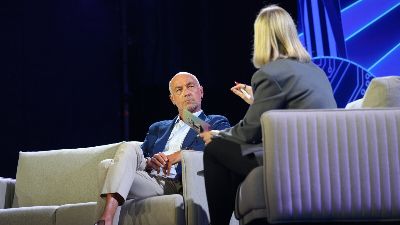
Fashion
Why Christian Louboutin's CEO Hired Jaden Smith as Men's Creative Director
Jun 19, 2026
Fashion